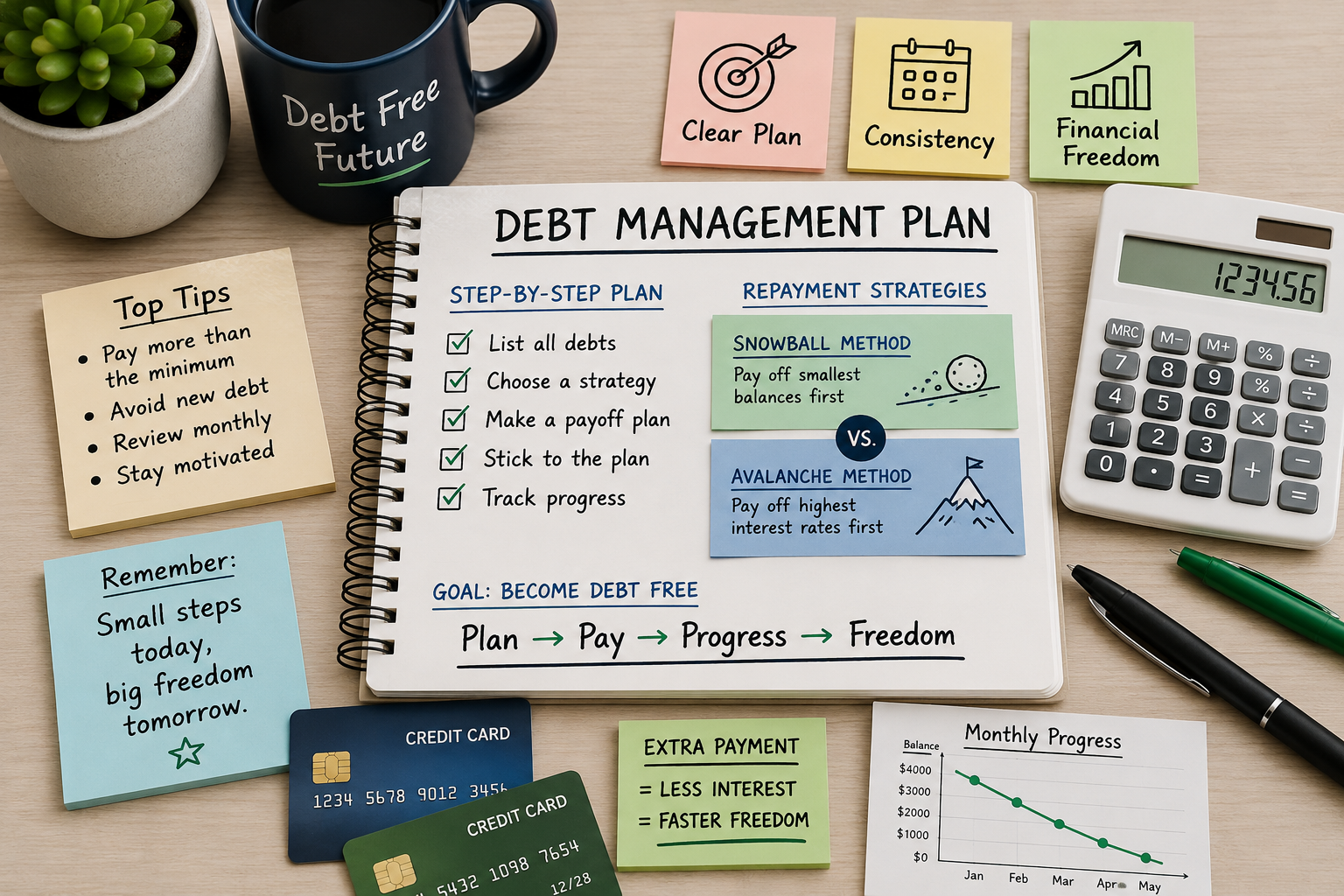
A debt management plan is a structured way to repay unsecured debt through organized monthly payments, usually with help from a credit counseling organization. Debt management can also include personal repayment strategies such as the debt snowball method, a debt repayment plan, budgeting changes, and tools such as a debt payoff calculator.
Introduction
Debt can become difficult to manage when balances, interest charges, due dates, and minimum payments all compete for the same monthly income. A person may keep making payments but feel like the balance is barely moving. That is when a clear debt management strategy becomes important.
Debt management does not always mean using a formal debt management program. Some people can create their own debt repayment plan with a budget, a payoff order, and consistent extra payments. Others may need help from a nonprofit credit counseling agency, especially when credit card payments are no longer affordable.
This guide explains what a debt management plan is, how a debt management program works, what a debt repayment plan includes, how the debt snowball method works, and how to pay off credit card debt with a realistic system.
What Is Debt Management?
Debt management is the process of organizing, reducing, and repaying debt in a structured way. Debt management can include budgeting, payment planning, interest reduction, credit counseling, and choosing a repayment strategy that fits a person’s income and debt level.
Debt management is different from ignoring debt or making random payments. A debt management strategy should show which debts exist, how much is owed, what interest rates apply, which payments are required, and how extra money will be used.
Debt management usually includes:
- A complete list of debts and balances
- Minimum monthly payments
- Interest rates and fees
- Due dates
- A monthly debt repayment amount
- A chosen debt repayment strategy
- A plan for avoiding new debt while paying old debt
What Is a Debt Management Plan?
A debt management plan is a structured repayment arrangement, often set up through a nonprofit credit counseling agency. Under many debt management plans, a person makes one monthly payment to the credit counseling organization, and the organization sends payments to creditors.
A debt management plan is usually designed for unsecured debts such as credit cards, personal loans, or medical bills. It is not the same as a new loan. It is also different from debt settlement, where a company may try to negotiate paying less than the full amount owed.
Debt management plan meaning
The meaning of a debt management plan is simple: it is an organized repayment plan that helps a person repay debts through a structured monthly payment system. The goal is usually to make repayment more manageable, reduce confusion, and help the person stay consistent until the debt is paid.
A debt repayment plan works better when it is connected to a clear personal budget that shows income, expenses, minimum payments, and extra payoff money.
Debt Management Program vs Debt Management Plan
The terms debt management program and debt management plan are often used together. A debt management program may describe the service offered by a credit counseling organization, while a debt management plan usually refers to the specific repayment arrangement created for the person.
Some countries and organizations use the spelling debt management programme. The meaning is usually similar: a structured program or plan designed to help a person manage and repay debt.
Debt management terms compared
| Term | Meaning | Best Used For |
|---|---|---|
| Debt management | The broad process of organizing and repaying debt. | Budgeting, repayment planning, and reducing debt stress. |
| Debt management plan | A structured repayment plan, often arranged through credit counseling. | People struggling to manage unsecured debt payments. |
| Debt management program | The service or program that helps create and manage the repayment plan. | People who need outside support and creditor coordination. |
| Debt management programme | Alternative spelling used in some regions. | Similar meaning to debt management program. |
What Is a Debt Repayment Plan?
A debt repayment plan is a written strategy for paying down debt over time. A debt repayment plan can be created independently or as part of a formal debt management plan.
A good debt repayment plan lists each debt, the balance, interest rate, minimum payment, due date, and payoff priority. It should also show how much extra money can be applied to debt each month.
For people with several credit card balances, debt consolidation may be one option to compare before choosing a final repayment strategy.
A debt repayment plan should include:
- All debts and account names
- Current balances
- Interest rates
- Minimum payments
- Due dates
- Chosen repayment method
- Monthly extra payment amount
- Estimated payoff timeline
Debt Repayment Plan Example
A debt repayment plan becomes easier to understand when all debts are placed in one table. The table below shows how a person might organize credit card debt and personal loan balances before choosing a payoff strategy.
| Debt | Balance | Interest Rate | Minimum Payment | Payoff Priority |
|---|---|---|---|---|
| Credit Card A | $1,200 | 24.99% | $45 | Smallest balance |
| Credit Card B | $4,500 | 21.99% | $135 | Highest interest |
| Personal Loan | $3,000 | 12.00% | $120 | Lower interest |
| Store Card | $800 | 28.99% | $35 | Smallest balance and high interest |
This table shows why debt repayment strategies matter. If the person wants quick motivation, the smallest balances may come first. If the person wants to reduce interest costs, the highest-interest debts may come first.
Debt Snowball Method Explained
The debt snowball method is a repayment strategy where a person pays the minimum on all debts and puts extra money toward the smallest balance first. After the smallest balance is paid off, the payment amount rolls into the next smallest balance.
The snowball method for debt is popular because it creates early wins. Paying off a small account can increase motivation and make the debt payoff process feel less overwhelming.
How the snowball debt method works
- List all debts from smallest balance to largest balance.
- Pay the minimum payment on every debt.
- Put any extra payment toward the smallest balance.
- After the smallest debt is paid, move that payment to the next smallest debt.
- Repeat the process until all debts are paid.
Debt snowball method example
| Debt | Balance | Minimum Payment | Snowball Order |
|---|---|---|---|
| Store Card | $800 | $35 | 1 |
| Credit Card A | $1,200 | $45 | 2 |
| Personal Loan | $3,000 | $120 | 3 |
| Credit Card B | $4,500 | $135 | 4 |
The debt snowball method may not always save the most interest, but it can help people stay committed because progress is visible early.
Debt Avalanche Method Explained
The debt avalanche method is a repayment strategy where a person pays the minimum on all debts and puts extra money toward the debt with the highest interest rate first. After the highest-interest debt is paid off, the extra payment moves to the next highest-interest debt.
The debt avalanche method is often more efficient mathematically because it targets the debts that cost the most in interest. However, it may take longer to feel progress if the highest-interest debt has a large balance.
Debt avalanche method example
| Debt | Balance | Interest Rate | Avalanche Order |
|---|---|---|---|
| Store Card | $800 | 28.99% | 1 |
| Credit Card A | $1,200 | 24.99% | 2 |
| Credit Card B | $4,500 | 21.99% | 3 |
| Personal Loan | $3,000 | 12.00% | 4 |
The avalanche method can be a good choice for people who are motivated by interest savings and can stay consistent even if the first payoff takes longer.
Debt Snowball vs Debt Avalanche
The debt snowball method and debt avalanche method both require minimum payments on all accounts and extra payments toward one priority debt. The difference is how the priority debt is chosen.
The snowball method chooses the smallest balance first. The avalanche method chooses the highest interest rate first.
| Method | Payoff Order | Main Benefit | Main Risk | Best For |
|---|---|---|---|---|
| Debt snowball method | Smallest balance first | Builds motivation through quick wins | May cost more interest | People who need momentum and visible progress |
| Debt avalanche method | Highest interest rate first | Can reduce total interest costs | May feel slower at the beginning | People motivated by math and long-term savings |
The best method is the one a person can actually follow. A mathematically perfect plan is not useful if the person quits after two months.
What Is the Best Way to Pay Off Credit Card Debt?
The best way to pay off credit card debt depends on the size of the balances, interest rates, monthly income, and behavior. For many people, the best approach is to stop adding new credit card debt, pay at least the minimum on every card, and send extra money to one priority balance.
People who need motivation may prefer the debt snowball method. People who want to reduce interest costs may prefer the debt avalanche method. People who cannot afford minimum payments may need credit counseling or a formal debt management plan.
Best credit card debt payoff options
| Situation | Possible Strategy | Why It May Help |
|---|---|---|
| Multiple small balances | Debt snowball method | Creates quick payoff wins and motivation. |
| High interest rates | Debt avalanche method | Targets the most expensive debt first. |
| Can afford payments but needs structure | Personal debt repayment plan | Organizes balances, due dates, and extra payments. |
| Struggling with minimum payments | Credit counseling or debt management plan | May provide structured support and creditor coordination. |
| Overspending continues | Budget reset and spending limits | Prevents new debt while old debt is being repaid. |
Paying down credit card balances may also improve your credit utilization ratio, especially when balances are high compared with available credit limits.
How to Pay Off Credit Card Debt Step by Step
Learning how to pay off credit card debt starts with creating a clear plan. Credit card debt is difficult because interest charges can grow quickly when balances stay high.
Step 1: Stop adding new balances
Debt repayment becomes harder if new purchases continue to increase balances. A temporary pause on non-essential card spending can help the payoff plan work.
Step 2: List every credit card balance
Write down each card, balance, interest rate, minimum payment, and due date. This creates a full view of the problem.
Step 3: Choose a repayment method
Choose either the debt snowball method, debt avalanche method, or a customized debt repayment plan based on your motivation and interest costs.
Step 4: Add extra payment money to the budget
Debt payoff should be a budget category. If extra payment money is not planned, it usually disappears into flexible spending.
Step 5: Track progress monthly
Review balances every month. If balances are not falling, check whether new charges, fees, interest, or low payments are slowing progress.
How to Pay Off Debt When Money Is Tight
When money is tight, the first goal is to protect required payments and avoid making the debt situation worse. A person may need to reduce household expenses, increase income, contact creditors, or seek nonprofit credit counseling.
If there is not enough room for extra payments, reviewing ways to reduce household expenses can help free up money for a debt repayment plan.
Practical steps when debt payments are difficult
- List all required bills and debt payments.
- Prioritize housing, food, utilities, transportation, and insurance.
- Stop using credit cards for non-essential spending.
- Call creditors before missing payments when possible.
- Review whether a debt management plan may help.
- Avoid high-pressure debt settlement companies.
- Use a budget to find small recurring savings.
If minimum payments are no longer affordable, a formal debt management plan through a reputable credit counseling organization may be worth reviewing.
When a Debt Management Plan May Help
A debt management plan may help when unsecured debt payments are difficult to manage, interest charges are high, and a person needs a structured monthly payment system. It may be especially useful when credit card debt is spread across several accounts.
A debt management plan is not right for everyone. It may require closing or not using enrolled credit cards, making regular payments, and staying in the program for several years.
A debt management plan may be worth considering if:
- Minimum payments are becoming difficult
- Credit card interest charges are slowing progress
- Multiple due dates are causing confusion
- You need help organizing unsecured debt
- You are willing to follow a structured repayment plan
- You can make a consistent monthly payment
Debt Management Plan vs Debt Settlement
A debt management plan is not the same as debt settlement. In a debt management plan, the goal is usually to repay the full debt through a structured plan. In debt settlement, a company may try to negotiate paying less than the full amount owed.
Debt settlement can be risky because it may involve stopping payments, fees, tax consequences, collection activity, and credit damage. People should understand the difference before choosing a debt relief option.
| Option | How It Works | Main Risk | Best For |
|---|---|---|---|
| Debt management plan | Structured repayment through a credit counseling organization. | Requires consistent payments and may limit credit card use. | People who want organized repayment support. |
| Debt settlement | Attempts to settle debt for less than the full amount owed. | May harm credit and create fees or tax issues. | People considering settlement should seek careful advice first. |
| Personal repayment plan | Self-managed payoff using snowball, avalanche, or custom strategy. | Requires discipline and accurate budgeting. | People who can afford payments and need structure. |
How a Debt Payoff Calculator Can Help
A debt payoff calculator helps estimate how long it may take to repay debt based on balance, interest rate, minimum payment, and extra payment amount. A calculator can also compare payoff timelines under different strategies.
A debt payoff calculator is useful because debt repayment can feel slow without a clear timeline. Seeing the difference between minimum payments and extra payments can make the payoff plan more concrete.
A debt payoff calculator can show:
- Estimated payoff date
- Total interest paid
- Impact of extra monthly payments
- Difference between snowball and avalanche methods
- How much faster debt can be paid with a larger payment
The calculator is only useful if the inputs are accurate. Use current balances, real interest rates, and a realistic extra payment amount.
Pepe The Toad’s Practical Note: Debt Payoff Needs a System
Debt payoff usually fails when it depends only on motivation. A stronger approach is to build a system: list every debt, choose a repayment order, schedule payments, and review balances every month.
The debt snowball method can help when motivation is the main problem. The avalanche method can help when interest costs are the main concern. A formal debt management plan may help when minimum payments are no longer manageable.
The most important step is to stop the debt from growing while the repayment plan is active. A payoff plan works best when it is connected to a budget, spending limits, and a small emergency fund.
Debt Management Checklist
- List every debt and balance.
- Write down interest rates and minimum payments.
- Choose a debt repayment strategy.
- Stop adding new non-essential debt.
- Add extra payments to the monthly budget.
- Use a debt payoff calculator to estimate timelines.
- Review whether the snowball or avalanche method fits better.
- Consider credit counseling if minimum payments are not manageable.
- Understand the difference between debt management and debt settlement.
- Track progress every month.
Frequently Asked Questions
What is debt management?
Debt management is the process of organizing and repaying debt through a structured plan. It can include budgeting, credit counseling, a debt management plan, a debt repayment plan, the debt snowball method, or another payoff strategy.
What is a debt management plan?
A debt management plan is a structured repayment plan, often arranged through a credit counseling organization. A person usually makes one monthly payment to the organization, and the organization distributes payments to creditors included in the plan.
What is a debt management program?
A debt management program is a service that helps create and manage a debt repayment plan. It may include credit counseling, creditor coordination, budgeting help, and a structured monthly payment plan for unsecured debts.
What is a debt repayment plan?
A debt repayment plan is a written strategy for paying down debt. It lists debts, balances, interest rates, minimum payments, due dates, repayment order, extra payment amount, and estimated payoff timeline.
What is the debt snowball method?
The debt snowball method is a repayment strategy where a person pays minimums on all debts and puts extra money toward the smallest balance first. After that balance is paid off, the payment rolls into the next smallest debt.
What is the snowball method for debt?
The snowball method for debt means paying debts from smallest balance to largest balance while making minimum payments on all accounts. The method is designed to create motivation through quick wins.
What is the best way to pay off credit card debt?
The best way to pay off credit card debt depends on balances, interest rates, income, and behavior. Many people use the snowball method for motivation, the avalanche method to reduce interest costs, or a debt management plan when payments are no longer manageable.
How do I pay off credit card debt?
To pay off credit card debt, stop adding new balances, list every card, compare interest rates and balances, choose a repayment method, pay minimums on all cards, and send extra money to one priority balance each month.
How do I pay off debt with low income?
To pay off debt with low income, start by protecting essential bills, reducing recurring expenses, avoiding new debt, paying minimums when possible, and using any extra money toward one priority debt. Credit counseling may help if payments are not affordable.
What does a debt payoff calculator do?
A debt payoff calculator estimates how long it may take to repay debt based on balance, interest rate, payment amount, and extra payments. It can help compare strategies and show how extra payments affect the payoff timeline.
Conclusion
Debt management works best when it is organized, realistic, and connected to a monthly budget. A person can use a self-managed debt repayment plan, the debt snowball method, the debt avalanche method, or a formal debt management plan depending on the situation.
The right debt strategy is the one that reduces balances consistently without creating new debt. Start by listing every debt, choosing a repayment order, planning monthly payments, and tracking progress. If the payments are no longer manageable, a reputable credit counseling organization may help review debt management plan options.