
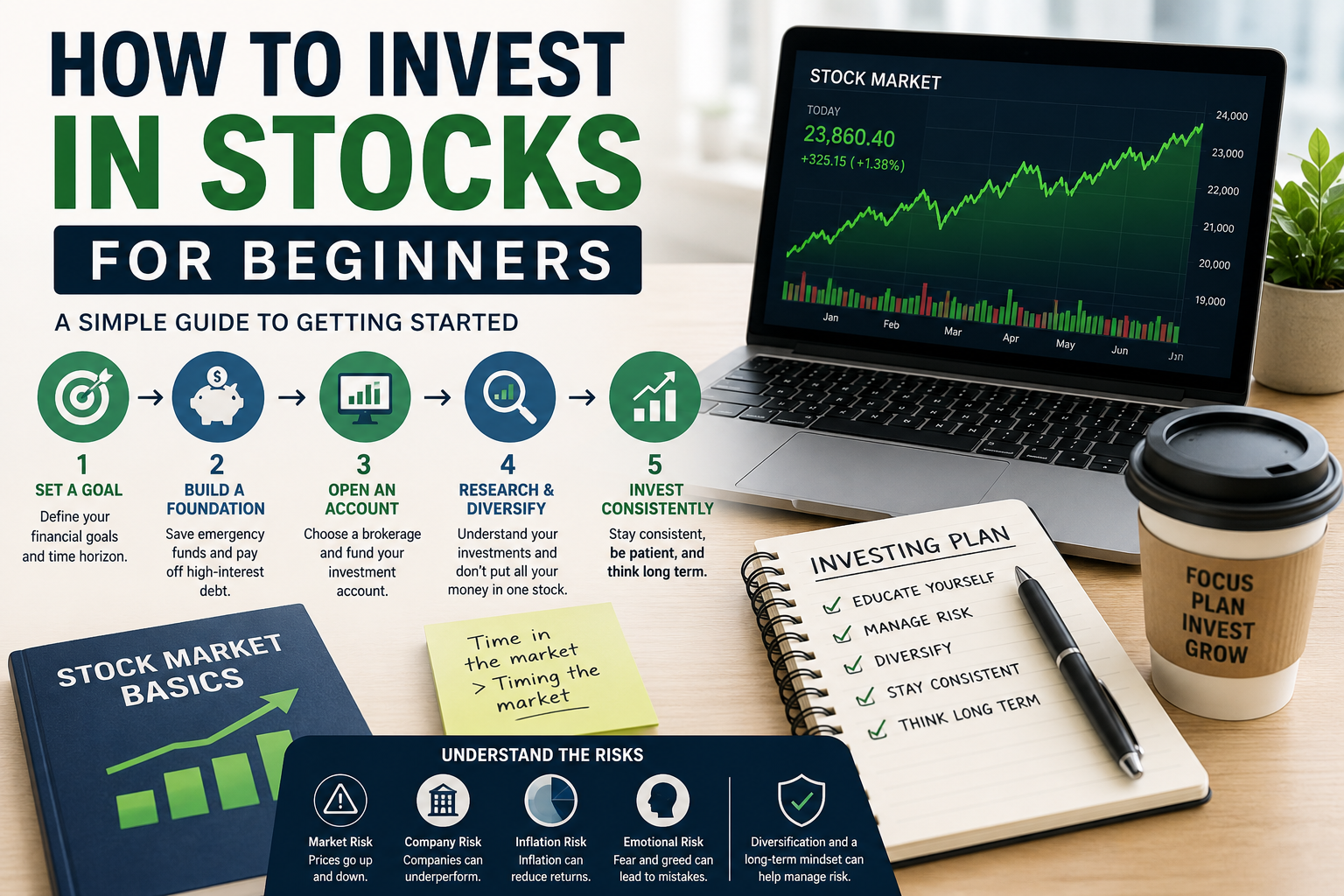
To invest in stocks, a beginner should learn how stocks work, set a financial goal, build emergency savings, choose an investment account, research investments, understand risk, and start with a realistic amount. Stock investing can help build wealth over time, but prices can rise and fall, so beginners should avoid rushing into random stock picks.
Introduction
Stock investing is one of the most common ways people try to build long-term wealth. Many beginners search for how to invest in stocks because they want their money to grow beyond a regular savings account.
The basic idea is simple: when you buy a stock, you buy a small ownership share in a company. If the company grows and the stock price rises, your investment may become more valuable. Some stocks may also pay dividends. However, stocks can also lose value, and there is no guaranteed return.
This guide explains how to invest in stocks, how to start investing in stocks, how to buy stocks online, what stock market investing means, and what risks beginners should understand before putting money into the market.
What Does Investing in Stocks Mean?
Investing in stocks means buying shares of publicly traded companies. A share of stock represents partial ownership in a company. Investors may make money if the stock price increases, if the company pays dividends, or both.
Stocks are also called equities. They can be bought and sold through brokerage accounts, investment apps, retirement accounts, and other investment platforms. The price of a stock changes based on supply, demand, company performance, investor expectations, interest rates, economic conditions, and many other factors.
Stock investing in simple terms
| Term | Simple Meaning | Beginner Example |
|---|---|---|
| Stock | A small ownership share in a company. | Buying shares of a public company through a brokerage account. |
| Share | One unit of ownership in a company. | Owning 5 shares of a company. |
| Brokerage account | An account used to buy and sell investments. | An online account where a beginner can buy stocks or funds. |
| Dividend | A payment some companies make to shareholders. | A company shares part of its profits with investors. |
| Capital gain | Profit from selling an investment for more than the purchase price. | Buying a stock at $50 and selling it at $70. |
How to Invest in Stocks as a Beginner
To invest in stocks as a beginner, start with education and planning before buying anything. The goal is not to guess the next hot stock. The goal is to build a process that matches your financial goals, risk tolerance, and time horizon.
Stock investing works better when it is connected to clear financial goals, such as retirement, long-term wealth building, or future financial independence.
Beginner steps for investing in stocks
- Set a clear goal. Decide whether you are investing for retirement, long-term wealth, education, or another financial goal.
- Check your basic finances first. Review your budget, emergency fund, and high-interest debt before investing aggressively.
- Understand stock market risk. Stock prices can rise and fall, sometimes quickly.
- Choose an investment account. Beginners commonly use brokerage accounts or retirement accounts.
- Compare investment options. Learn the difference between individual stocks, index funds, ETFs, and mutual funds.
- Decide how much to invest. Start with an amount you can afford without damaging your basic financial stability.
- Place your first order carefully. Understand what you are buying before clicking submit.
- Track and review your investments. Review your plan regularly, but avoid emotional daily trading.
How to Start Investing in Stocks
The best way to start investing in stocks is to prepare before opening an account or buying shares. A beginner should know why they are investing, how long the money can stay invested, and how much risk they can handle.
Starting without a plan can lead to emotional decisions. Beginners may buy because a stock is trending, sell during a market drop, or put too much money into one company. A simple plan helps reduce those mistakes.
Before putting money into the stock market, many beginners should first build an emergency fund so short-term surprises do not force them to sell investments too early.
Before investing in stocks, ask:
- What is the goal for this money?
- Can this money stay invested for several years?
- Do I have emergency savings?
- Do I have high-interest debt that should be handled first?
- How much loss could I tolerate without panic selling?
- Do I understand the investment I am buying?
- Will I buy individual stocks, funds, or a mix?
How to Buy Stocks Online
To buy stocks online, you usually need to open an investment account with a brokerage or investing platform, deposit money, search for the stock or fund, choose an order type, review the details, and submit the order.
Basic online stock buying process
| Step | What You Do | Beginner Tip |
|---|---|---|
| 1. Choose a platform | Pick a brokerage or investment platform. | Compare fees, account types, tools, and available investments. |
| 2. Open an account | Provide required personal and financial information. | Use accurate information and secure login settings. |
| 3. Fund the account | Transfer money from a bank account. | Start with money you do not need for immediate bills. |
| 4. Search the investment | Find the stock, ETF, or fund you want to buy. | Check the ticker symbol carefully. |
| 5. Choose order details | Enter amount, order type, and timing. | Review before submitting. |
| 6. Track the investment | Monitor performance and review your plan. | Avoid checking so often that emotions control decisions. |
How to Buy Stocks: Market Orders vs Limit Orders
When learning how to buy stocks, beginners should understand common order types. Two basic order types are market orders and limit orders.
A market order is designed to buy or sell quickly at the best available current price. A limit order sets the maximum price you are willing to pay when buying or the minimum price you are willing to accept when selling.
Market order and limit order compared
| Order Type | How It Works | Main Benefit | Main Risk |
|---|---|---|---|
| Market order | Buys or sells at the best available market price. | Usually faster execution. | Final price may differ from what you expected in a fast-moving market. |
| Limit order | Buys or sells only at a specified price or better. | More control over price. | The order may not execute if the price does not reach the limit. |
Beginners should slow down before placing orders. A small mistake with ticker symbols, order size, or order type can create confusion or unwanted risk.
Investing in Stocks vs Trading Stocks
Investing in stocks and trading stocks are not the same. Investing usually means buying with a longer time horizon. Trading usually means buying and selling more frequently to try to profit from shorter-term price movement.
Most beginners are better served by learning long-term investing before trying short-term trading. Trading can involve higher stress, more decisions, more transaction activity, and greater risk of emotional mistakes.
Investing and trading compared
| Approach | Time Horizon | Main Focus | Beginner Risk |
|---|---|---|---|
| Investing | Years or decades | Long-term growth, income, or wealth building. | Market drops can still cause losses, but the plan is usually longer-term. |
| Trading | Days, weeks, or months | Short-term price movement. | Higher emotional pressure and greater chance of impulsive decisions. |
Individual Stocks vs Funds
Beginners often think stock market investing means choosing individual companies. That is one option, but it is not the only option. Many investors use funds to spread money across many companies at once.
Individual stocks can offer direct ownership in specific companies, but they can also create concentration risk. Funds such as index funds, mutual funds, or ETFs can provide broader exposure, although they also carry risk and can lose value.
Individual stocks and funds compared
| Investment Type | What It Is | Possible Advantage | Possible Risk |
|---|---|---|---|
| Individual stock | Shares of one company. | Direct ownership in a company you choose. | High exposure to one company’s performance. |
| ETF | A fund traded on an exchange like a stock. | Can provide exposure to many investments in one purchase. | Value can still fall with the market or sector. |
| Mutual fund | A pooled investment fund managed according to a strategy. | Can offer diversification and professional management. | May include fees and investment risk. |
| Index fund | A fund designed to track a market index. | Often used for broad market exposure. | Will still move with the index it tracks. |
What Are the Risks of Stock Market Investing?
Stock market investing involves risk. A stock can lose value because of weak company performance, economic problems, interest rate changes, competition, investor sentiment, or broad market declines.
Beginners should not treat stocks like guaranteed savings accounts. Stock prices can move up and down. Some companies fail. Some investments may never recover. Even diversified portfolios can lose value during market downturns.
Common stock market risks
| Risk | Meaning | Beginner Example |
|---|---|---|
| Market risk | The risk that the overall market declines. | Most stocks fall during a broad market downturn. |
| Company risk | The risk that one company performs poorly. | A company loses customers, profits, or competitive position. |
| Concentration risk | The risk of holding too much in one stock or sector. | A beginner puts most money into one popular stock. |
| Liquidity risk | The risk of not being able to sell easily at a fair price. | A thinly traded stock has a wide price gap. |
| Emotional risk | The risk of making decisions based on fear or excitement. | Selling after a drop or buying only because a stock is trending. |
How Beginners Can Manage Stock Investing Risk
Risk cannot be removed completely, but it can be managed. A beginner can reduce avoidable risk by diversifying, avoiding overconcentration, investing with a long-term mindset, and not using money needed for short-term expenses.
Risk management habits for beginners
- Do not invest money needed for rent, bills, or near-term emergencies.
- Avoid putting all money into one stock.
- Learn how diversification works.
- Consider broad funds if individual stock picking feels too risky.
- Understand fees before choosing a platform or fund.
- Do not borrow money to invest as a beginner.
- Use strong account security and two-factor authentication.
- Review investments on a schedule instead of reacting daily.
- Be careful with social media stock tips.
How Much Money Do You Need to Start Investing in Stocks?
Many beginners can start investing with a small amount, depending on the platform and account type. Some platforms allow fractional shares, which let investors buy part of a share instead of a full share.
The better question is not only how much money is required to start. The better question is how much money can be invested without hurting the rest of the financial plan.
Before deciding how much to invest, check:
- Monthly income and expenses
- Emergency savings
- High-interest debt
- Upcoming large bills
- Time horizon for the money
- Comfort with market losses
A beginner does not need to invest a large amount immediately. Starting small can help build confidence while learning how the stock market works.
How to Research a Stock Before Buying
Researching a stock means understanding the company, not just looking at the price chart. A stock is connected to a real business with revenue, expenses, competition, debt, management, and future expectations.
Beginner stock research questions
- What does the company do?
- How does the company make money?
- Is revenue growing, stable, or declining?
- Does the company make a profit?
- How much debt does the company have?
- Who are the competitors?
- Does the stock price already assume strong future growth?
- Does the company pay a dividend?
- What could go wrong with the business?
Beginners should be careful with stocks they do not understand. If the investment thesis cannot be explained simply, more research may be needed before buying.
When comparing potential investments, understanding return on investment can help beginners review gains, losses, fees, and risk more clearly.
Should Beginners Buy Individual Stocks?
Beginners can buy individual stocks, but they should understand the risk. Buying one or two stocks is not the same as owning a diversified portfolio.
Some beginners prefer starting with broad funds before buying individual stocks. Others use a smaller portion of their portfolio for individual stocks while keeping most money in diversified investments. The best approach depends on risk tolerance, knowledge, time, and goals.
Individual stock checklist
- You understand the company’s business.
- You know why you want to own the stock.
- You understand what could make the stock lose value.
- You are not putting all your money into one company.
- You are not buying only because of hype or social media.
- You can hold through normal market volatility.
Stock Market Investing for Long-Term Wealth
Stock market investing is often used for long-term wealth building because stocks can grow over time as companies grow. However, the path is not smooth. Markets can fall sharply, recover slowly, or stay volatile for long periods.
A long-term investor focuses on time, consistency, diversification, and realistic expectations. The goal is not to predict every market move. The goal is to stay aligned with a plan that can survive normal market ups and downs.
Long-term investing habits
- Invest on a regular schedule when appropriate.
- Keep emergency money outside the stock market.
- Diversify across more than one investment.
- Review goals and risk tolerance over time.
- Avoid panic selling during normal volatility.
- Rebalance if your portfolio becomes too concentrated.
Over long periods, reinvested returns may benefit from compound interest, which is one reason time and consistency matter in stock investing.
How to Invest in Stocks for Beginners in 2026
How to invest in stocks for beginners in 2026 is not very different from other years at the basic level. The core steps are still education, planning, account selection, risk management, and consistent investing.
What changes over time are platforms, fees, market conditions, available tools, tax rules, and investor behavior. Beginners should avoid assuming that a popular app, trend, or stock tip automatically creates a good investing plan.
Beginner-friendly 2026 stock investing checklist
- Use trusted educational sources before buying.
- Check whether an investment professional or platform is properly registered where required.
- Understand account fees and fund fees.
- Protect login information and account security.
- Avoid investing based only on social media trends.
- Keep the plan connected to long-term financial goals.
Common Beginner Mistakes When Investing in Stocks
Many stock investing mistakes come from moving too fast. Beginners often feel pressure to buy quickly because they fear missing out. This can lead to weak research, poor diversification, and emotional decisions.
Common mistakes include:
- Buying a stock without understanding the company.
- Putting too much money into one stock.
- Investing emergency savings.
- Ignoring high-interest debt.
- Following online hype without research.
- Trying to time the market perfectly.
- Panic selling after a normal market drop.
- Ignoring taxes and fees.
- Confusing a rising stock price with a safe investment.
- Checking the account too often and reacting emotionally.
Pepe The Toad’s Practical Note: Do Not Start With Hype
Stock investing becomes dangerous when beginners start with hype instead of a plan. A trending stock, popular influencer, or exciting price chart is not the same as a researched investment decision.
A better starting point is boring but stronger: understand your goal, protect emergency savings, manage expensive debt, choose an account carefully, diversify, and only invest money that can handle market risk.
Good stock investing is not about looking smart in one week. It is about building a process that can survive years of changing markets.
Beginner Stock Investing Checklist
- You understand what a stock is.
- You know why you want to invest.
- You have reviewed your budget and emergency savings.
- You understand that stocks can lose value.
- You have chosen an appropriate investment account.
- You know the difference between stocks, ETFs, mutual funds, and index funds.
- You understand basic order types.
- You are not putting all your money into one company.
- You have a review schedule.
- You are not investing based only on hype.
Frequently Asked Questions
How do I invest in stocks as a beginner?
To invest in stocks as a beginner, learn how stocks work, set a goal, choose an investment account, deposit money, research investments, understand risk, and start with an amount that fits your financial situation.
How do I start investing in stocks?
Start investing in stocks by reviewing your budget, building emergency savings, learning basic stock market terms, choosing a brokerage or investment account, and deciding whether you want individual stocks, funds, or both.
How do you buy stocks online?
To buy stocks online, open an investment account, fund the account, search for the stock or fund, choose order details, review the trade, and submit the order. Beginners should check ticker symbols and order types carefully.
What is stock market investing?
Stock market investing means buying ownership shares in companies or funds that hold stocks. Investors may benefit from price growth or dividends, but stock prices can also fall and create losses.
What are the risks of stock market investing?
The risks of stock market investing include market declines, company failure, concentration risk, emotional decision-making, liquidity risk, and loss of principal. Diversification can help manage risk, but it cannot eliminate risk completely.
Is investing in stocks good for beginners?
Investing in stocks can be suitable for beginners who understand risk, have a long-term plan, and avoid putting all their money into one company. Beginners should not treat stocks as guaranteed income or quick money.
How much money do I need to start investing in stocks?
The amount needed to start investing depends on the platform, account type, and investment. Some platforms allow small deposits or fractional shares. The important question is how much you can invest without harming your basic financial stability.
Should beginners buy individual stocks or funds?
Beginners can buy individual stocks, but funds may provide broader diversification. Individual stocks create more company-specific risk, while diversified funds can spread money across many companies. Both options can lose value.
Can I lose money investing in stocks?
Yes. Stocks can lose value, and investors can lose money. Losses can happen because of company problems, market downturns, economic changes, poor timing, or emotional decisions.
What is the safest way to invest in stocks?
No stock investment is completely safe. Beginners can manage risk by diversifying, investing for the long term, avoiding excessive concentration, keeping emergency savings outside the market, and not investing money needed soon.
Conclusion
Learning how to invest in stocks starts with understanding what stocks are, how the stock market works, and what risks are involved. Beginners do not need to rush into individual stock picking. A simple plan is more useful than a fast decision.
Stock investing can support long-term wealth building, but it should fit inside a larger financial system. That system includes budgeting, emergency savings, debt management, financial goals, and regular review. The goal is not to predict every market move. The goal is to invest carefully, consistently, and with realistic expectations.