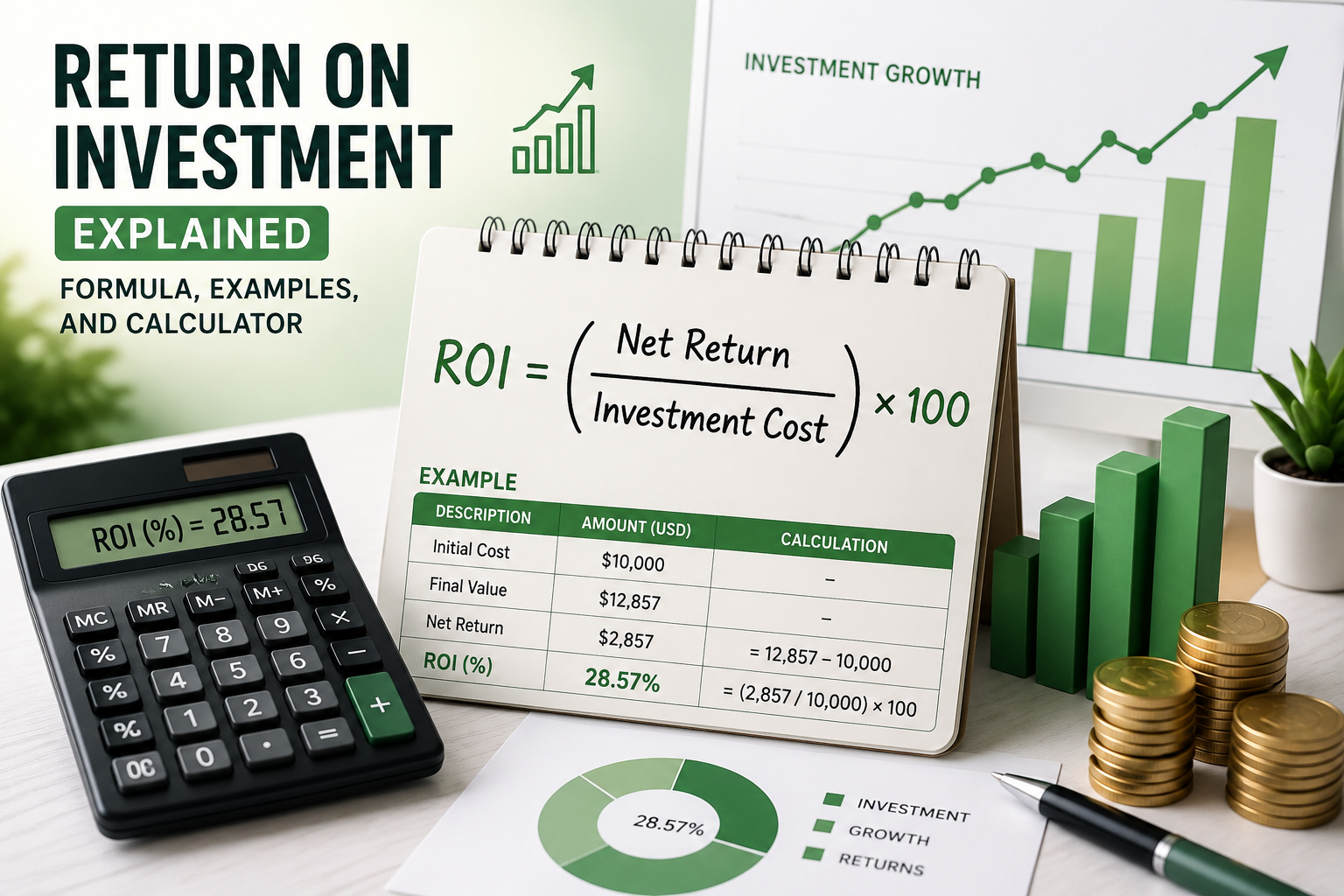
Return on investment is a percentage that shows how much profit or loss an investment produced compared with its original cost. The basic return on investment formula is: ROI = net return divided by investment cost, multiplied by 100. ROI can compare investments, but it should be reviewed with time, fees, taxes, and risk.
Introduction
Return on investment is one of the most common ways to measure whether an investment produced a gain or loss. It is often shortened to ROI.
Many people search for return on investment because they want a simple number that explains whether an investment was worth it. ROI can help compare stocks, funds, real estate, education costs, business spending, or personal financial decisions. However, ROI can be misleading if it ignores time, risk, fees, taxes, or cash flow.
This guide explains what return on investment means, how the return on investment formula works, how to calculate return on investment, how an ROI calculator works, and how to compare investment returns with simple examples.
What Is Return on Investment?
Return on investment is a financial measurement that compares the net gain or loss from an investment with the original cost of that investment.
Return on investment is usually shown as a percentage. A positive ROI means the investment gained value compared with its cost. A negative ROI means the investment lost value compared with its cost.
Return on investment meaning
| Term | Simple Meaning | Example |
|---|---|---|
| Return on investment | The gain or loss compared with the amount invested. | An investment gains $200 after costing $1,000. |
| ROI | The shortened name for return on investment. | 20% ROI means the gain was 20% of the cost. |
| Net return | The investment gain after subtracting the original cost and relevant costs. | Final value minus cost, fees, and other expenses. |
| Investment cost | The amount of money used to buy or fund the investment. | $1,000 used to buy an investment. |
Return on Investment Formula
The standard return on investment formula compares net return with investment cost.
ROI = (Net Return / Investment Cost) × 100
Another common version of the ROI formula is:
ROI = ((Final Value – Initial Cost) / Initial Cost) × 100
ROI formula breakdown
| Formula Part | Meaning | Example |
|---|---|---|
| Final value | What the investment is worth after the holding period. | $1,300 |
| Initial cost | What the investment originally cost. | $1,000 |
| Net return | Final value minus initial cost and relevant costs. | $300 before fees or taxes |
| ROI percentage | Net return divided by initial cost, multiplied by 100. | 30% |
How to Calculate Return on Investment
To calculate return on investment, subtract the original investment cost from the final investment value. Then divide the result by the original investment cost and multiply by 100.
Step-by-step ROI calculation
- Find the initial investment cost. This is the amount paid to buy or start the investment.
- Find the final investment value. This is the amount the investment is worth when measured or sold.
- Subtract the initial cost from the final value. This gives the gross gain or loss.
- Subtract relevant costs if needed. Fees, commissions, repairs, taxes, and other costs can change the true return.
- Divide the net return by the initial cost. This turns the result into a return ratio.
- Multiply by 100. This turns the ratio into a percentage.
Return on Investment Example
A simple return on investment example can show how the formula works.
Suppose a person invests $1,000. Later, the investment is worth $1,250. The gain is $250.
ROI = ($250 / $1,000) × 100
ROI = 25%
Simple ROI example table
| Item | Amount |
|---|---|
| Initial investment cost | $1,000 |
| Final investment value | $1,250 |
| Net return before fees and taxes | $250 |
| Return on investment | 25% |
In this example, the investment produced a 25% return before considering fees, taxes, inflation, or time period.
ROI Example With Fees
Fees can reduce return on investment. A simple ROI calculation can look better than the real result if costs are ignored.
Suppose a person invests $1,000, sells the investment for $1,250, and pays $50 in fees. The net return is $200, not $250.
ROI = ($200 / $1,000) × 100
ROI = 20%
ROI before and after fees
| Calculation | Without Fees | With $50 Fees |
|---|---|---|
| Initial cost | $1,000 | $1,000 |
| Final value | $1,250 | $1,250 |
| Net return | $250 | $200 |
| ROI | 25% | 20% |
This example shows why ROI should include costs when the goal is to measure the real investment result.
What Is an ROI Calculator?
An ROI calculator is a tool that estimates return on investment using investment cost, final value, income, fees, and sometimes time period.
An ROI calculator can reduce math mistakes and help compare scenarios. However, an ROI calculator is only as accurate as the numbers entered. If fees, taxes, inflation, or risk are ignored, the result can be incomplete.
An ROI calculator usually asks for:
- Initial investment amount
- Final value or sale value
- Additional income from the investment
- Fees or transaction costs
- Holding period
- Additional contributions, if relevant
Investment Calculator vs ROI Calculator
An investment calculator and an ROI calculator are related, but they are not always the same tool.
An ROI calculator usually measures gain or loss compared with cost. An investment calculator may estimate future growth using contributions, interest rate, investment return assumptions, time, and compounding.
Investment calculator and ROI calculator compared
| Tool | Main Purpose | Best Use |
|---|---|---|
| ROI calculator | Measures gain or loss compared with investment cost. | Comparing actual or estimated return from one investment. |
| Investment calculator | Projects how money may grow over time. | Estimating future value with contributions and expected returns. |
| Investment return calculator | Can measure or estimate investment performance. | Reviewing return, time period, and growth assumptions. |
For long-term growth estimates, understanding compound interest can help explain how reinvested returns may build over time.
Good Return on Investment: What Does It Mean?
A good return on investment depends on the investment type, time period, risk level, fees, inflation, taxes, and personal goal.
A 10% ROI may be strong for a low-risk short-term decision but weak for a high-risk investment over many years. A 50% ROI may look excellent, but it may not be attractive if it required extreme risk, high debt, or a very long time period.
Why “good ROI” depends on context
| Factor | Why It Changes ROI Meaning | Example |
|---|---|---|
| Time period | The same ROI can mean different things over one year versus ten years. | 20% in one year is different from 20% over ten years. |
| Risk | Higher-risk investments should be judged more carefully. | A risky investment needs more than a small return to justify the risk. |
| Fees | Fees reduce the real return. | A 12% gross return may become 9% after costs. |
| Taxes | Taxes may reduce what the investor keeps. | A taxable gain may produce a lower after-tax result. |
| Inflation | Inflation reduces purchasing power. | A return may look positive but still buy less in real terms. |
ROI vs Annual Return
ROI and annual return are different measurements. ROI shows total gain or loss compared with investment cost. Annual return shows investment performance over a one-year period.
This difference matters because ROI alone does not always show how long the money was invested. A 30% ROI over one year is very different from a 30% ROI over ten years.
ROI and annual return compared
| Measurement | What It Shows | Limitation |
|---|---|---|
| ROI | Total return compared with original cost. | Does not always show time period clearly. |
| Annual return | Return measured over one year. | May require more calculation when returns vary over time. |
| Annualized return | Average yearly return over a multi-year period. | Can hide year-to-year volatility. |
ROI Example: Same ROI, Different Time Period
Time changes the meaning of return on investment. Two investments can have the same ROI but very different annual performance.
| Investment | Initial Cost | Final Value | Total ROI | Time Period |
|---|---|---|---|---|
| Investment A | $1,000 | $1,300 | 30% | 1 year |
| Investment B | $1,000 | $1,300 | 30% | 10 years |
Both investments show a 30% ROI, but Investment A produced that return much faster. This is why ROI should be reviewed with the holding period.
ROI for Stocks and Funds
Return on investment can be used to measure stocks and funds, but the calculation should include price changes, dividends, fees, and taxes when possible.
For stocks, ROI may include the difference between purchase price and sale price. For dividend-paying stocks or funds, ROI may also include dividend income. For funds, expense ratios and account fees can reduce the real return.
Stock ROI example
| Item | Amount |
|---|---|
| Purchase cost | $2,000 |
| Sale value | $2,300 |
| Dividends received | $80 |
| Fees | $20 |
| Net return | $360 |
| ROI | 18% |
In this example, the net return is $360 because the investor gained $300 from price growth, received $80 in dividends, and paid $20 in fees.
Before judging stock returns only by ROI, beginners should first understand how to invest in stocks, how market risk works, and why short-term performance can be misleading.
ROI for Personal Finance Decisions
Return on investment can also apply to personal finance decisions, not only stocks or funds. A person may compare the cost and benefit of education, home improvements, certifications, tools, or debt payoff decisions.
Personal finance ROI can be harder to measure because some benefits are not purely financial. For example, a certification may increase income, but it may also require time, stress, and opportunity cost.
Personal finance ROI examples
| Decision | Possible Cost | Possible Return | What to Watch |
|---|---|---|---|
| Professional course | Tuition, time, materials. | Higher income or better job opportunities. | The income increase may not happen immediately. |
| Home improvement | Materials, labor, permits. | Higher home value or lower utility costs. | Not every upgrade increases resale value. |
| Debt payoff | Cash used to reduce balance. | Interest savings and improved cash flow. | Emergency savings should still be protected. |
| Investing | Initial contribution and future contributions. | Potential long-term growth. | Investment returns are not guaranteed. |
ROI and Risk
Return on investment should not be reviewed without risk. A high ROI may come from high risk, leverage, concentration, or luck. A low ROI may be acceptable if the investment was safer, more liquid, or used for a short-term goal.
A beginner should avoid choosing an investment only because the projected ROI looks high. A useful investment review should include downside risk, time horizon, liquidity, fees, and the chance that the result may be lower than expected.
ROI risk checklist
- Could the investment lose value?
- How long must the money stay invested?
- Are fees included in the ROI calculation?
- Are taxes included in the result?
- Is the return guaranteed or only projected?
- Could inflation reduce the real return?
- Is too much money concentrated in one investment?
- Would a loss damage the monthly budget or emergency fund?
ROI is most useful when it fits inside a broader financial planning process that also considers goals, risk, time horizon, fees, taxes, and cash flow.
Common ROI Mistakes
ROI is useful, but it can be misleading when calculated too simply. Many ROI mistakes come from ignoring costs, time, risk, and cash flow.
Common return on investment mistakes include:
- Ignoring fees and transaction costs.
- Ignoring taxes on gains or income.
- Comparing investments with different time periods.
- Assuming projected ROI is guaranteed.
- Ignoring risk and volatility.
- Counting unrealized gains as guaranteed profit.
- Comparing a liquid investment with an illiquid investment as if they are the same.
- Ignoring inflation and purchasing power.
- Using ROI alone to make every financial decision.
Pepe The Toad’s Practical Note: ROI Is a Filter, Not a Final Answer
Return on investment is useful because it turns an investment result into a simple percentage. The danger is treating that percentage as the only decision factor.
A strong ROI number does not automatically mean an investment is safe, suitable, or worth choosing. A weak ROI number does not always mean the decision was useless, especially if the decision reduced risk, improved stability, or supported a necessary goal.
The better approach is to use ROI as a filter. Compare the return, then review time, risk, fees, taxes, liquidity, and how the investment fits into the larger financial plan.
Return on Investment Checklist
- You know the initial investment cost.
- You know the final value or estimated value.
- You include investment income when relevant.
- You subtract fees and transaction costs when possible.
- You consider taxes if the gain is taxable.
- You compare the ROI with the time period.
- You review risk before judging the return.
- You avoid treating projected ROI as guaranteed.
- You compare ROI with personal financial goals.
- You use ROI with other planning tools, not by itself.
Frequently Asked Questions
What is return on investment?
Return on investment is a percentage that compares the gain or loss from an investment with the original investment cost. ROI helps show whether an investment produced a positive or negative result.
What does return on investment mean?
Return on investment means how much profit or loss an investment produced compared with its cost. A positive ROI means the investment gained value. A negative ROI means the investment lost value.
What is the return on investment formula?
The return on investment formula is ROI = net return divided by investment cost, multiplied by 100. A common version is ROI = ((final value – initial cost) / initial cost) × 100.
How do you calculate return on investment?
To calculate return on investment, subtract the initial investment cost from the final value, divide the result by the initial cost, and multiply by 100. Include fees, income, and other costs when you need a more accurate result.
What is an ROI calculator?
An ROI calculator is a tool that estimates return on investment using cost, final value, income, fees, and sometimes time period. It helps compare investment scenarios and reduce manual calculation errors.
What is a good return on investment?
A good return on investment depends on risk, time period, fees, taxes, inflation, and personal goals. ROI should not be judged alone because a high return may come with high risk or long holding periods.
Is ROI the same as profit?
ROI is not the same as profit. Profit is usually shown as a dollar amount. ROI shows profit or loss as a percentage of the original investment cost.
Can return on investment be negative?
Yes. Return on investment can be negative when the final value of an investment is lower than the original cost after considering relevant income and expenses.
Is ROI the same as annual return?
No. ROI shows total gain or loss compared with cost. Annual return shows investment performance over a one-year period. The same ROI can mean different things depending on how long the investment was held.
Why can ROI be misleading?
ROI can be misleading when it ignores time, risk, fees, taxes, inflation, liquidity, or cash flow. ROI is useful, but it should be reviewed with the full investment context.
Conclusion
Return on investment is a simple way to measure investment performance. The basic ROI formula compares net return with investment cost and shows the result as a percentage.
ROI is useful for comparing investments, but ROI should not be the only factor in a financial decision. A good investment review should also consider time period, fees, taxes, inflation, risk, liquidity, and the person’s larger financial plan.