
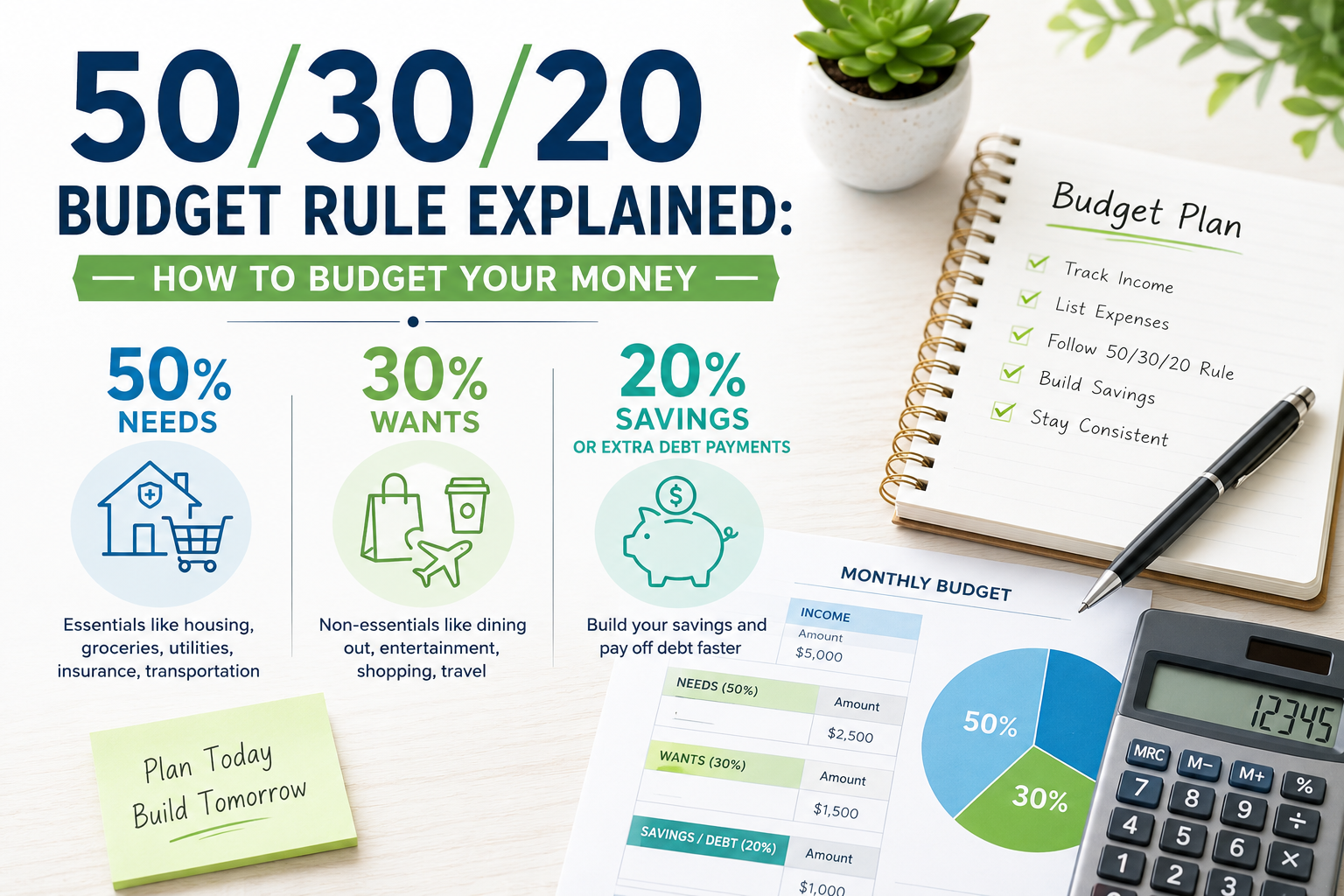
The 50 30 20 rule is a budgeting method that divides after-tax income into three broad categories: 50% for needs, 30% for wants, and 20% for savings or extra debt payments. The rule can simplify budgeting, but it may need adjusting when housing, debt, or income pressure is high.
Introduction
The 50/30/20 rule is one of the simplest ways to budget money because it does not require dozens of detailed categories. Instead, the rule groups spending into three main buckets: needs, wants, and savings.
Many people search for the 50 30 20 rule because they want a clear budgeting rule that is easy to remember. The method can help beginners understand whether monthly income is being used mostly for essentials, lifestyle spending, or future financial progress.
This guide explains what the 50/30/20 budget rule is, how the 50 30 20 budget works, how to calculate the rule, when to use a 50/30/20 rule calculator, and when this budgeting rule may need to be adjusted.
What Is the 50/30/20 Budget Rule?
The 50/30/20 budget rule is a percentage-based budgeting method. The rule divides after-tax income into three categories: 50% for needs, 30% for wants, and 20% for savings or extra debt repayment.
The main purpose of the 50/30/20 rule is to create a simple spending structure. Instead of tracking every small category separately, the person first checks whether total spending fits within the three broad limits.
50/30/20 rule meaning
| Category | Percentage | Simple Meaning | Examples |
|---|---|---|---|
| Needs | 50% | Essential costs required for daily life. | Rent, mortgage, utilities, groceries, transportation, insurance, minimum debt payments. |
| Wants | 30% | Flexible spending that improves lifestyle but is not essential. | Dining out, entertainment, subscriptions, hobbies, travel, nonessential shopping. |
| Savings and extra debt payments | 20% | Money used for future goals, emergency savings, investing, or extra debt payoff. | Emergency fund, retirement savings, investment contributions, extra credit card payments. |
How Does the 50/30/20 Rule Work?
The 50 30 20 rule works by starting with after-tax income. After-tax income is the money available after taxes and required paycheck deductions. The budget then divides that income into needs, wants, and savings.
For example, if monthly after-tax income is $4,000, the 50/30/20 budget rule would assign $2,000 to needs, $1,200 to wants, and $800 to savings or extra debt payments.
50 30 20 budget example
| Monthly After-Tax Income | Needs: 50% | Wants: 30% | Savings or Extra Debt: 20% |
|---|---|---|---|
| $2,500 | $1,250 | $750 | $500 |
| $3,500 | $1,750 | $1,050 | $700 |
| $4,000 | $2,000 | $1,200 | $800 |
| $5,000 | $2,500 | $1,500 | $1,000 |
50 30 20 Rule Formula
The 50 30 20 rule formula is simple because each category uses a percentage of after-tax income.
| Budget Category | Formula | Example With $4,000 Income |
|---|---|---|
| Needs | After-tax income × 0.50 | $4,000 × 0.50 = $2,000 |
| Wants | After-tax income × 0.30 | $4,000 × 0.30 = $1,200 |
| Savings or extra debt payments | After-tax income × 0.20 | $4,000 × 0.20 = $800 |
The 50 20 30 rule is usually the same concept written in a different order. Some people say 50 20 30 rule because they list needs, savings, and wants instead of needs, wants, and savings.
What Counts as Needs in the 50/30/20 Rule?
Needs are essential expenses that are required for basic living, work, safety, or legal obligations. In the 50/30/20 budget rule, needs should usually fit within 50% of after-tax income.
The needs category can become difficult when housing, transportation, insurance, or debt payments are high. If needs are above 50%, the budget may need adjusting instead of forcing unrealistic cuts.
Common needs categories
- Rent or mortgage payment
- Basic utilities
- Groceries
- Transportation to work or school
- Health insurance
- Auto insurance
- Minimum debt payments
- Childcare needed for work
- Basic phone or internet service when required for work or daily life
- Necessary medical costs
What Counts as Wants in the 50/30/20 Rule?
Wants are expenses that improve comfort, convenience, or enjoyment but are not required for basic survival or required obligations. In the 50/30/20 rule, wants usually fit within 30% of after-tax income.
The wants category is not automatically bad. A budget that removes every enjoyable expense may be hard to maintain. The goal is to keep wants intentional and limited enough that they do not block savings, debt payoff, or essential expenses.
Common wants categories
- Restaurants and takeout
- Streaming services
- Entertainment
- Travel and vacations
- Hobbies
- Nonessential clothing
- Upgraded phone plans
- Gym memberships not required for medical reasons
- Convenience purchases
- Home decor and lifestyle upgrades
What Counts as Savings in the 50/30/20 Rule?
The savings category includes money used for emergency savings, long-term goals, investing, and extra debt payments above minimum payments. In the 50/30/20 budget rule, this category usually receives 20% of after-tax income.
Minimum debt payments usually belong in needs because they are required. Extra debt payments can belong in the 20% category because they improve the future financial position.
Common savings and debt categories
| Savings Category | Purpose | Example |
|---|---|---|
| Emergency fund | Protects against unexpected expenses. | Saving for car repairs, medical bills, or income gaps. |
| Retirement savings | Supports long-term financial security. | Contributing to a retirement account. |
| Investing | Builds long-term growth potential. | Adding money to a brokerage or investment account. |
| Sinking funds | Prepares for planned future expenses. | Saving monthly for holidays, car repairs, or insurance premiums. |
| Extra debt payments | Reduces debt faster than minimum payments. | Paying extra toward credit card debt or loans. |
The 20% category works better when it supports a consistent saving money habit instead of only using whatever is left at the end of the month.
50/30/20 Rule Calculator: How to Use One
A 50/30/20 rule calculator divides after-tax income into needs, wants, and savings categories. The calculator can save time and reduce math mistakes, especially for people who want a quick monthly budget target.
A 50 30 20 rule calculator is not a full budget by itself. It gives target amounts, but a person still needs to list actual bills, actual spending, savings goals, and debt payments.
A 50/30/20 rule calculator usually needs:
- Monthly after-tax income
- Current essential expenses
- Current flexible spending
- Current savings amount
- Current debt payments
- Possible adjustment for high housing or high debt
50/30/20 Rule Calculator Example
The table below shows how a 50/30/20 rule calculator might divide income at different income levels.
| After-Tax Income | 50% Needs | 30% Wants | 20% Savings or Extra Debt |
|---|---|---|---|
| $2,800 | $1,400 | $840 | $560 |
| $3,200 | $1,600 | $960 | $640 |
| $4,500 | $2,250 | $1,350 | $900 |
| $6,000 | $3,000 | $1,800 | $1,200 |
The calculator results should be compared with real spending. If the real needs category is much higher than the calculator target, the budget may require a modified version of the 50 30 20 budget.
How to Budget Money With the 50/30/20 Rule
To budget money with the 50/30/20 rule, start with after-tax income, group expenses into needs, wants, and savings, compare each group with the percentage target, and adjust the categories that are too high.
Step-by-step 50 30 20 budgeting process
- Calculate after-tax income. Use take-home pay instead of gross salary.
- List all monthly expenses. Include fixed bills, variable spending, savings, and debt payments.
- Separate needs from wants. Place essential expenses in needs and flexible expenses in wants.
- Separate minimum debt from extra debt payments. Minimum payments usually belong in needs, while extra payments can count toward the 20% category.
- Calculate category totals. Add all needs, all wants, and all savings or extra debt payments.
- Compare totals with 50/30/20 targets. Find which category is over or under the guideline.
- Adjust the budget. Reduce flexible spending, review fixed costs, or modify the rule if the standard percentages are unrealistic.
- Review monthly. A budget rule works best when actual spending is checked against the plan.
50/30/20 Budget Rule Example
This example shows how a person with $4,000 in monthly after-tax income might use the 50/30/20 budget rule.
| Category | Target Percentage | Target Amount | Example Spending | Status |
|---|---|---|---|---|
| Needs | 50% | $2,000 | $2,150 | $150 over target |
| Wants | 30% | $1,200 | $950 | $250 under target |
| Savings and extra debt payments | 20% | $800 | $900 | $100 over target |
In this example, needs are slightly high, but wants are below the target. The budget may still work because the person is saving more than 20% and has enough room in wants to cover the higher needs category.
When the 50/30/20 Rule Works Well
The 50/30/20 rule works well when after-tax income is stable, essential expenses are manageable, and the person wants a simple budgeting framework instead of a detailed category-by-category system.
The 50/30/20 rule may work well if:
- Income is predictable.
- Housing costs are not too high.
- Minimum debt payments are manageable.
- The person wants a simple budget rule.
- The person does not want to track dozens of categories.
- The person can save close to 20% of after-tax income.
- The person is trying to balance needs, wants, and future goals.
When the 50/30/20 Rule May Not Work
The 50/30/20 rule may not work when needs are already much higher than 50% of after-tax income. This can happen because of high rent, high mortgage payments, childcare costs, medical expenses, transportation costs, or debt payments.
The rule can also be difficult for people with irregular income. A freelancer, contractor, seasonal worker, or commission-based worker may need to budget from average income or lowest expected income instead of one fixed monthly number.
Warning signs the rule needs adjusting
- Needs are consistently above 50% of after-tax income.
- Savings cannot reach 20% even after reducing wants.
- Debt payments are crowding out basic expenses.
- Income changes significantly from month to month.
- Housing costs take up too much of the budget.
- The budget creates guilt but not clarity.
- The person stops tracking because the rule feels impossible.
How to Adjust the 50/30/20 Budget Rule
The 50/30/20 budget rule is a guideline, not a law. A person can adjust the percentages when the standard rule does not match real income, debt, or cost of living.
The most important part is keeping the budget intentional. If needs must take more than 50%, the adjustment should be visible. The person should know whether the change is temporary, unavoidable, or caused by spending choices that can be changed.
Common adjusted budget splits
| Adjusted Rule | Needs | Wants | Savings or Extra Debt | When It May Fit |
|---|---|---|---|---|
| 60/20/20 | 60% | 20% | 20% | High essential costs but still strong savings focus. |
| 60/30/10 | 60% | 30% | 10% | Temporary period when savings capacity is lower. |
| 70/20/10 | 70% | 20% | 10% | High housing, childcare, medical, or debt pressure. |
| 50/20/30 | 50% | 20% | 30% | Higher savings goal or aggressive debt payoff period. |
An adjusted rule should still support progress. If savings stay low for many months, the person may need to review income, fixed expenses, or debt strategy.
If debt payments are the main reason the standard split does not work, a clear debt management plan can help decide which balances should receive extra money first.
50/30/20 Rule vs Detailed Budget
The 50/30/20 rule is simpler than a detailed monthly budget. A detailed budget tracks specific categories such as groceries, transportation, subscriptions, insurance, and dining out.
The best choice depends on the person’s situation. A beginner may start with the 50 30 20 rule and then move to a more detailed budget if spending is hard to control.
50/30/20 rule and detailed budget compared
| Budget Type | How It Works | Best For | Main Limitation |
|---|---|---|---|
| 50/30/20 rule | Uses three broad categories: needs, wants, and savings. | Beginners who want a simple budgeting rule. | May hide specific spending problems inside broad categories. |
| Detailed monthly budget | Tracks many individual categories. | People who need more control over spending. | Can feel time-consuming if there are too many categories. |
| Budget template | Uses a reusable layout for income, expenses, savings, and actual spending. | People who want structure and monthly review. | Must be updated consistently to stay useful. |
If the three-category rule feels too broad, a monthly budget template can help track income, expenses, savings, and actual spending in more detail.
Needs, Wants, and Savings Budget
A needs, wants, and savings budget helps reduce confusion because every expense has a purpose. The key challenge is classifying expenses honestly.
Some expenses can fall into different categories depending on the situation. For example, transportation to work is usually a need. A luxury car upgrade may be a want. A basic phone plan may be a need, while a premium phone upgrade may be a want.
How to classify tricky expenses
| Expense | Usually Need | Usually Want | How to Decide |
|---|---|---|---|
| Food | Groceries for normal meals. | Restaurants, takeout, premium snacks. | Ask whether the spending is basic nutrition or convenience/lifestyle. |
| Transportation | Basic transportation to work or school. | Luxury upgrades or unnecessary rideshares. | Ask whether the cost is required or chosen for comfort. |
| Phone | Basic service needed for work and daily life. | Premium device upgrades or unnecessary extras. | Separate required service from lifestyle upgrades. |
| Clothing | Required work clothes or basic replacement items. | Fashion shopping or nonessential upgrades. | Ask whether the purchase solves a real need or a preference. |
How to Budget Your Money if the 50/30/20 Rule Feels Hard
If the 50/30/20 rule feels hard, start by tracking real spending for one month. The rule may feel impossible because the person does not know which category is causing the problem.
After tracking spending, compare real numbers with the 50/30/20 targets. The gap will show whether the problem is high needs, high wants, low income, high debt, or missing irregular expenses.
Practical steps when the rule feels unrealistic
- Track one full month of spending. Do not guess the numbers.
- Group expenses into needs, wants, and savings. Use broad categories first.
- Find the biggest gap. Check whether needs, wants, or savings is farthest from the target.
- Adjust wants first if possible. Flexible spending is usually easier to change than rent or insurance.
- Review fixed costs if needs are too high. Look at housing, transportation, subscriptions, insurance, and debt payments.
- Choose a temporary adjusted rule. A 60/30/10 budget may be more realistic during a difficult period.
- Review again next month. The first version of a budget is rarely perfect.
Common 50/30/20 Rule Mistakes
The 50/30/20 rule is simple, but it can still be used incorrectly. Most mistakes happen when income is calculated wrong, categories are classified too loosely, or the rule is treated as perfect for every situation.
Common mistakes include:
- Using gross income instead of after-tax income.
- Counting minimum debt payments as savings instead of needs.
- Putting too many lifestyle expenses into the needs category.
- Ignoring irregular expenses such as annual insurance, car repairs, or gifts.
- Assuming the 50/30/20 rule works for every income level and city.
- Forcing the rule even when housing or debt makes it unrealistic.
- Not tracking actual spending during the month.
- Saving whatever is left instead of assigning savings at the start.
- Using the rule as a one-time calculation instead of a monthly review habit.
Pepe The Toad’s Practical Note: The Rule Is a Starting Point, Not a Judge
The 50 30 20 rule is useful because it gives a quick picture of money balance. The rule can show whether essentials are too high, wants are crowding out goals, or savings are being ignored.
The mistake is treating the 50/30/20 budget rule like a moral test. A person living in a high-cost area or carrying unavoidable expenses may not fit the rule immediately.
A better approach is to use the rule as a diagnostic tool. Compare real spending with the target, identify the biggest pressure point, and then adjust the budget in a way that still supports savings, debt payoff, and long-term stability.
50/30/20 Rule Checklist
- You use after-tax income, not gross salary.
- You calculate 50% for needs.
- You calculate 30% for wants.
- You calculate 20% for savings or extra debt payments.
- You classify expenses honestly.
- You include minimum debt payments in needs.
- You include extra debt payments in the 20% category.
- You compare target amounts with actual spending.
- You adjust the rule when real life requires it.
- You review the budget every month.
Frequently Asked Questions
What is the 50/30/20 budget rule?
The 50/30/20 budget rule is a budgeting method that divides after-tax income into 50% for needs, 30% for wants, and 20% for savings or extra debt payments.
What is the 50 30 20 rule?
The 50 30 20 rule is a simple budgeting rule for organizing money into needs, wants, and savings. It helps beginners check whether monthly spending supports both current expenses and future goals.
How does the 50/30/20 rule work?
The 50/30/20 rule works by taking after-tax income and splitting it into three categories: needs, wants, and savings. The percentages give target limits for each category.
What is the 50 20 30 rule?
The 50 20 30 rule is usually the same budgeting concept as the 50/30/20 rule, but the categories are listed in a different order: 50% needs, 20% savings, and 30% wants.
What is a 50/30/20 rule calculator?
A 50/30/20 rule calculator is a tool that divides after-tax income into target amounts for needs, wants, and savings. The calculator gives a starting point, but actual expenses still need to be tracked.
Does the 50/30/20 rule use gross income or net income?
The 50/30/20 rule usually uses after-tax income, also called take-home income or net income. Gross income can make the budget look more affordable than it really is.
Are debt payments needs or savings in the 50/30/20 rule?
Minimum debt payments usually count as needs because they are required obligations. Extra debt payments can count toward the 20% savings or extra debt category because they improve future financial stability.
Is the 50/30/20 rule good for beginners?
The 50/30/20 rule can be good for beginners because it is simple and easy to remember. Beginners may still need a detailed budget template if spending is hard to control.
What if my needs are more than 50%?
If needs are more than 50%, the budget may need adjustment. Review housing, transportation, insurance, debt payments, and income. A temporary 60/30/10 or 70/20/10 budget may be more realistic.
How do I budget my money with the 50/30/20 rule?
To budget money with the 50/30/20 rule, calculate after-tax income, divide it into needs, wants, and savings targets, track actual spending, and adjust categories that are over the target.
Conclusion
The 50/30/20 rule is a simple budgeting method that divides after-tax income into 50% needs, 30% wants, and 20% savings or extra debt payments. The rule is useful because it gives a quick structure for monthly money decisions.
The 50/30/20 budget rule works best when it is used as a flexible guide. If housing, debt, income changes, or essential expenses make the standard split unrealistic, the percentages can be adjusted. The goal is not to follow the rule perfectly. The goal is to create a budget that covers needs, controls wants, and protects future financial progress.