
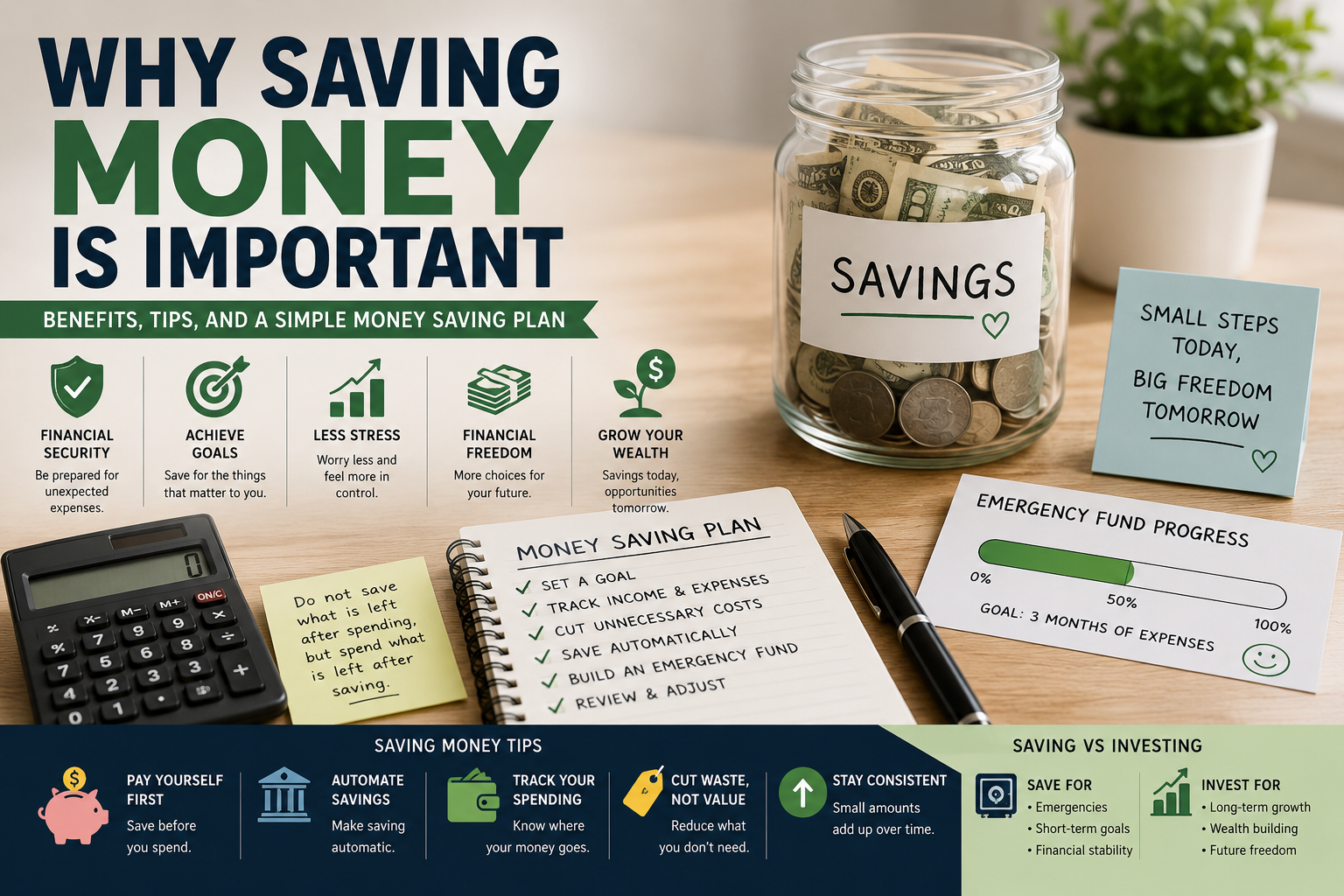
Saving money is important because it gives you more control over emergencies, bills, goals, and future choices. A savings habit can reduce financial stress, limit the need for high-interest debt, support short-term goals, and create a stronger foundation before investing. The key is to build a simple money saving plan that you can repeat.
Introduction
Saving money is one of the most basic personal finance habits, but it is also one of the most powerful. It helps protect daily life, supports future goals, and gives a person more financial options when unexpected expenses appear.
Many people search for saving money tips because they know they should save, but they do not always know where to start. The problem is not always lack of discipline. Sometimes the problem is lack of a clear money saving plan.
This guide explains what saving money means, why saving money is important, the benefits of saving money, practical tips for saving money, how to build a simple money saving plan, and when saving vs investing becomes the next question.
What Is Saving Money?
Saving money means setting aside part of your income instead of spending all of it immediately. Savings can be kept for emergencies, planned purchases, future goals, or financial security.
Saving money is not only about keeping cash in a bank account. It is also a habit of creating space between income and spending. When money is saved consistently, it becomes easier to handle surprises without relying on credit cards, loans, or last-minute borrowing.
Saving money in simple terms
| Concept | Simple Meaning | Example |
|---|---|---|
| Saving money | Keeping part of your income for later use. | Saving $100 each month in a separate account. |
| Emergency savings | Money reserved for unexpected expenses. | Car repairs, medical bills, or temporary income loss. |
| Money saving plan | A repeatable system for saving consistently. | Automatic transfer after each paycheck. |
| Savings goal | A specific reason for saving money. | Emergency fund, vacation, home repair, or debt payoff support. |
Why Saving Money Is Important
Saving money is important because it protects you from financial pressure. Without savings, even a small unexpected expense can create stress, debt, or delayed payments.
Savings give you more choices. They can help you repair a car, cover a medical bill, handle a job gap, move to a better opportunity, or avoid using expensive debt for normal life surprises.
The importance of saving money
- Savings help cover unexpected expenses.
- Savings reduce dependence on credit cards.
- Savings make financial goals easier to reach.
- Savings can lower stress during uncertain periods.
- Savings create flexibility when income changes.
- Savings help separate emergencies from everyday spending.
- Savings can prepare you for investing later.
Benefits of Saving Money
The benefits of saving money are both practical and emotional. Practically, savings help pay for real expenses. Emotionally, savings can make life feel less reactive because every surprise does not become a financial crisis.
Main benefits of saving money
| Benefit | How It Helps | Example |
|---|---|---|
| Emergency protection | Gives money for unexpected costs. | Paying for a car repair without using a credit card. |
| Less debt pressure | Reduces the need to borrow for normal surprises. | Using savings instead of a high-interest loan. |
| Better goal progress | Turns future goals into monthly actions. | Saving each month for a move, trip, or home repair. |
| More flexibility | Creates options when life changes. | Handling a job change or income gap more calmly. |
| Stronger investing foundation | Protects long-term investments from early withdrawals. | Keeping emergency money outside the stock market. |
Saving Money vs Spending Everything
When all income is spent, there is no buffer between normal life and financial stress. A person may be able to pay bills during a normal month but still feel unstable when something unexpected happens.
Saving money creates a small layer of protection. Even a modest amount can reduce the need to make rushed decisions. Over time, the habit becomes more important than any single deposit.
Comparison table
| Situation | Without Savings | With Savings |
|---|---|---|
| Unexpected bill | May require credit card debt or borrowing. | Can be paid from emergency savings. |
| Job interruption | Immediate pressure to cover basic expenses. | More time to adjust and make decisions. |
| Large planned purchase | May require financing or delayed payment. | Can be planned with a savings goal. |
| Investment opportunity | Harder to invest because cash is tight. | More room to invest after basic stability is built. |
How Much Money Should You Save?
The right savings amount depends on income, expenses, debt, dependents, job stability, and goals. There is no single number that works for everyone.
A beginner can start with a small first target, such as one week of essential expenses or a starter emergency fund. After that, the goal can grow toward one month, three months, or more of essential expenses depending on personal needs.
Savings target examples
| Savings Level | Purpose | Best For |
|---|---|---|
| Starter savings | Small cushion for minor surprises. | Beginners who currently have little or no savings. |
| One month of expenses | Basic short-term stability. | People who want more breathing room. |
| Three months of expenses | Stronger emergency protection. | People with variable income or higher financial responsibility. |
| Six months or more | Deeper protection against income loss or major disruption. | Self-employed workers, families, or people with less stable income. |
For short-term protection, many people start by building an emergency fund before moving toward larger savings or investing goals.
Simple Money Saving Plan
A money saving plan should be simple enough to repeat. The best plan is not the one that looks perfect on paper. The best plan is the one you can actually follow during normal months.
Simple money saving plan steps
- Choose one savings goal. Start with an emergency fund or another clear short-term goal.
- Set a target amount. Choose a number that is realistic for your income and expenses.
- Pick a monthly savings amount. Decide how much can be saved without breaking the budget.
- Separate the money. Keep savings away from daily spending money.
- Automate the transfer if possible. A scheduled transfer can make saving easier.
- Review once per month. Check progress and adjust if income or expenses change.
A simple budget split like the 50 30 20 rule can help show how much income may go toward needs, wants, and savings each month.
Money Saving Plan Example
A written plan makes saving money easier to track. The example below shows how a person can turn a broad goal into monthly action.
| Savings Goal | Target Amount | Current Savings | Monthly Savings | Estimated Timeline |
|---|---|---|---|---|
| Starter emergency fund | $1,000 | $250 | $150 | 5 months |
| Car repair fund | $600 | $100 | $100 | 5 months |
| Holiday spending fund | $900 | $0 | $75 | 12 months |
| One month of expenses | $2,800 | $800 | $250 | 8 months |
The numbers can be changed for any income level. The main point is to give each savings goal a target, a timeline, and a monthly action.
Saving Money Tips That Actually Help
Good saving money tips should make saving easier, not unrealistic. A useful tip either reduces waste, increases consistency, or makes money harder to spend accidentally.
Practical tips for saving money
- Pay yourself first. Move savings before spending the rest of your income.
- Use a separate savings account. Separation reduces the temptation to spend saved money.
- Automate savings. Even a small automatic transfer can build momentum.
- Track recurring expenses. Subscriptions and small repeat charges can quietly reduce savings.
- Plan irregular expenses. Save monthly for annual bills, car repairs, gifts, and holidays.
- Use a waiting period for nonessential purchases. A 24-hour delay can prevent impulse spending.
- Save windfalls carefully. Tax refunds, bonuses, and gifts can support savings goals.
- Reduce one expense at a time. Small changes are easier to keep than extreme cuts.
- Review the budget monthly. Savings improve when spending is visible.
Why Saving Money Is Important Before Investing
Saving money is important before investing because investments can lose value and may not be suitable for short-term emergencies. If all available money is invested, a sudden expense may force a person to sell at a bad time.
Savings and investing both matter, but they serve different purposes. Savings are usually better for short-term needs and emergency protection. Investing is usually used for longer-term goals where money has time to handle market ups and downs.
Saving vs investing
| Question | Saving Money | Investing |
|---|---|---|
| Main purpose | Safety, access, and short-term goals. | Long-term growth potential. |
| Risk level | Usually lower when kept in safe accounts. | Higher because investments can lose value. |
| Best time frame | Short-term needs and emergencies. | Long-term goals such as retirement or wealth building. |
| Common mistake | Saving with no goal or keeping too much idle cash forever. | Investing emergency money or chasing hype. |
Saving vs Investing: When Should You Save First?
Save first when the money may be needed soon, when emergency savings are low, or when high-interest debt could create pressure. Investing can come later when basic stability is stronger.
Save first when:
- You do not have emergency savings.
- You may need the money in the next few months.
- Your income is unstable.
- You have upcoming bills or planned expenses.
- You are carrying high-interest debt.
- You would panic if an investment dropped in value.
Investing may make more sense when:
- You have emergency savings.
- Your high-interest debt is under control.
- You have long-term financial goals.
- You understand investment risk.
- You can leave the money invested for years.
- You are not investing based only on social media or hype.
After emergency savings and high-interest debt are under control, beginners can learn how to invest in stocks as one possible step toward long-term wealth building.
How to Start Saving Money With a Tight Budget
Saving money with a tight budget is harder, but it is not impossible. The first goal should be consistency, not a large amount. A small repeated transfer can build the habit and create a starting cushion.
Small-budget saving ideas
- Start with a very small weekly amount.
- Save loose change or round-ups if your bank offers that feature.
- Cancel one unused subscription.
- Set aside part of any extra income.
- Use a grocery list to reduce impulse spending.
- Plan meals around food already at home.
- Delay nonessential purchases for 24 hours.
- Review bank statements for silent spending leaks.
The first savings goal does not have to be impressive. It just needs to start the habit.
If saving feels difficult, reviewing ways to reduce household expenses can help free up money for a realistic savings plan.
How to Keep Saving Money Long Term
Saving money becomes easier when it is connected to a system. Motivation may come and go, but systems can keep working even when life is busy.
Long-term savings habits
- Use automatic transfers.
- Name savings accounts by goal.
- Review savings progress monthly.
- Increase savings when income rises.
- Keep emergency savings separate from spending money.
- Plan for irregular expenses before they happen.
- Celebrate milestones without spending the savings.
Common Saving Money Mistakes
Saving money sounds simple, but many people make the same mistakes. The most common problem is trying to save whatever is left at the end of the month. Often, nothing is left.
Common mistakes include:
- Saving without a clear goal.
- Keeping savings in the same account as spending money.
- Waiting until the end of the month to save.
- Setting a savings goal that is too aggressive.
- Ignoring irregular expenses.
- Using emergency savings for nonemergencies.
- Trying to invest before building basic cash savings.
- Giving up after one difficult month.
Pepe The Toad’s Practical Note: Saving Is a System, Not a Mood
Saving money works best when it does not depend on motivation. Motivation is useful, but it is not reliable enough to build a financial foundation by itself.
A simple system is stronger: choose a goal, separate the money, automate the transfer, track the progress, and adjust when life changes. Even small savings can become meaningful when the habit continues.
The goal is not to save perfectly every month. The goal is to keep moving in the right direction and protect your future self from unnecessary financial pressure.
Saving Money Checklist
- You know why saving money is important.
- You have one clear savings goal.
- You know your target amount.
- You know how much you can save each month.
- You keep savings separate from spending money.
- You have a starter emergency fund plan.
- You track progress monthly.
- You understand the difference between saving and investing.
- You avoid using emergency savings for nonemergencies.
- You adjust the plan when income or expenses change.
Frequently Asked Questions
Why is saving money important?
Saving money is important because it helps cover emergencies, reduces dependence on debt, supports financial goals, and creates more flexibility. Savings can make unexpected expenses easier to handle without disrupting the entire budget.
What is saving money?
Saving money means setting aside part of your income for future use instead of spending all of it immediately. Savings can be used for emergencies, planned purchases, short-term goals, and financial security.
What are the benefits of saving money?
The benefits of saving money include emergency protection, less financial stress, fewer debt problems, better goal progress, more flexibility, and a stronger foundation before investing.
What are the best saving money tips?
Useful saving money tips include automating transfers, using a separate savings account, tracking recurring expenses, planning irregular bills, using a waiting period before purchases, and starting with a realistic monthly amount.
What is a money saving plan?
A money saving plan is a simple system for saving consistently. It usually includes a goal, target amount, monthly savings amount, separate savings location, and regular progress review.
How much money should I save each month?
The amount depends on income, expenses, debt, and goals. A beginner can start with a small amount and increase it later. The most important step is building a repeatable savings habit.
Is saving money better than investing?
Saving money and investing serve different purposes. Saving is usually better for emergencies and short-term goals. Investing is usually used for long-term growth, but it includes risk and can lose value.
Should I save before investing?
Many beginners should build emergency savings before investing heavily. Savings help cover short-term surprises so investments do not need to be sold early during a market drop.
How can I start saving money with a tight budget?
Start with a small amount, reduce one recurring expense, use a separate savings account, save part of extra income, and track spending. Consistency matters more than starting with a large amount.
Why do people fail to save money?
People often fail to save money because they wait until the end of the month, mix savings with spending money, set unrealistic goals, ignore irregular expenses, or do not have a clear savings plan.
Conclusion
Saving money is important because it creates financial stability, protects against emergencies, supports future goals, and reduces the need for expensive debt. It is one of the first habits that makes the rest of personal finance easier.
A strong money saving plan does not need to be complicated. Start with one goal, choose a realistic amount, separate the money, automate when possible, and review progress regularly. Over time, the habit of saving money can create more freedom, less stress, and better long-term financial choices.