
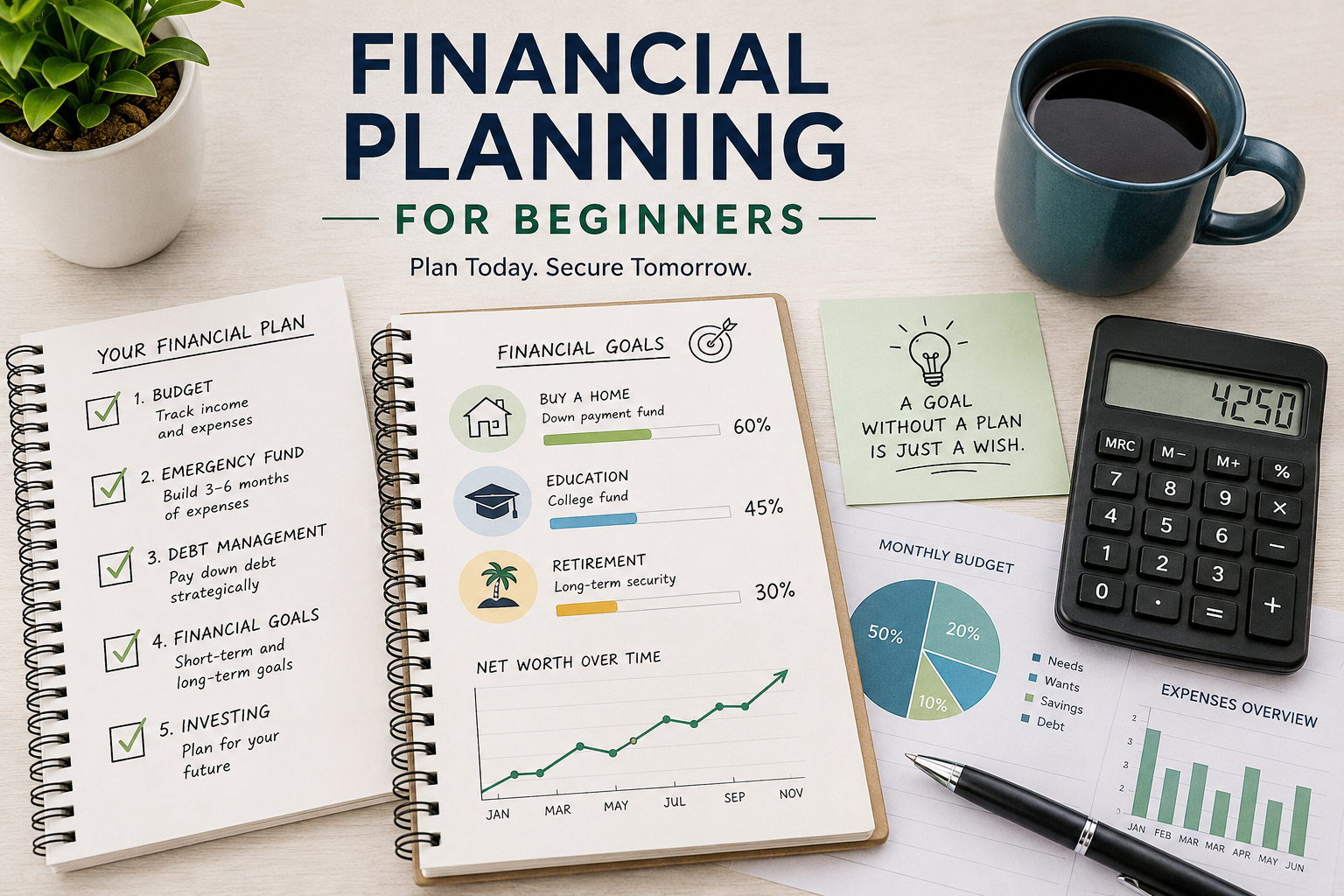
Financial planning is the process of organizing income, expenses, savings, debt, insurance, goals, and investments into one clear money plan. A personal financial plan helps a person understand where money is going, what needs to improve, and which steps should come first. The goal is not perfection. The goal is better financial direction.
Introduction
Financial planning can sound complicated, but the basic idea is simple. It means creating a practical plan for how money should be earned, spent, saved, protected, and used for future goals.
Many people search for financial planning because they want a clearer system. They may already have a budget, savings goal, debt payment, or investment account, but the pieces feel disconnected. A personal financial plan connects those pieces into one process.
This guide explains what financial planning is, what a financial plan includes, why financial planning is important, how to create a financial plan, and how to use a simple financial plan example to organize your money step by step.
What Is Financial Planning?
Financial planning is the process of reviewing your current financial situation, setting goals, organizing money decisions, and creating steps to improve financial stability over time.
Personal financial planning usually includes budgeting, saving, debt management, insurance, investing, retirement planning, and regular review. It is not only for wealthy people. Beginners can use financial planning to make everyday money decisions more organized.
Financial planning in simple terms
| Financial Planning Area | What It Means | Beginner Example |
|---|---|---|
| Budgeting | Planning how income will be used each month. | Tracking rent, groceries, bills, savings, and debt payments. |
| Saving | Setting money aside for emergencies and goals. | Building an emergency fund or car repair fund. |
| Debt management | Organizing balances and payment priorities. | Paying down credit card debt before investing aggressively. |
| Risk protection | Preparing for unexpected financial problems. | Emergency savings, insurance, and avoiding overborrowing. |
| Investing | Using money for long-term growth potential. | Learning about stocks, funds, and long-term investing risk. |
What Is a Financial Plan?
A financial plan is a written or digital document that shows your current money situation, your goals, and the steps needed to move from where you are now to where you want to be.
A personal financial plan does not need to be complicated. It can be a spreadsheet, document, notebook, or planning page. The important part is that it gives a clear view of income, expenses, savings, debt, goals, and next actions.
A simple financial plan usually includes:
- Monthly income
- Monthly expenses
- Savings goals
- Emergency fund target
- Debt balances and payment plan
- Insurance or risk protection needs
- Investment or retirement goals
- Net worth tracking
- Short-term and long-term financial goals
- Review schedule
Why Is Financial Planning Important?
Financial planning is important because it helps turn money decisions into a system. Without a plan, income can disappear into bills, debt, and random spending without clear progress.
A financial plan helps show what should happen first. For many beginners, that may mean building a budget, creating emergency savings, reducing high-interest debt, and then planning for investing or long-term goals.
Importance of financial planning
| Reason | Why It Matters | Practical Result |
|---|---|---|
| Clarity | Shows where money is going. | Less guessing and more informed decisions. |
| Control | Creates a plan before money is spent. | Better spending, saving, and debt choices. |
| Goal progress | Connects money habits to specific outcomes. | More progress toward savings, debt payoff, and investing goals. |
| Emergency protection | Prepares for unexpected expenses. | Less dependence on credit cards or loans during surprises. |
| Long-term planning | Helps money support future needs. | More organized investing, retirement, and wealth-building decisions. |
Financial Planning Process
The financial planning process is a step-by-step method for reviewing money, setting goals, building a plan, and updating that plan over time.
A beginner does not need to complete everything in one day. Financial planning works best when it is treated as an ongoing process instead of a one-time task.
Financial planning process steps
| Step | Planning Action | Question to Ask |
|---|---|---|
| Step 1 | Review your current situation. | How much do I earn, spend, save, and owe? |
| Step 2 | Set financial goals. | What do I want my money to accomplish? |
| Step 3 | Build a budget. | Does my monthly plan support my goals? |
| Step 4 | Create emergency savings. | Can I handle unexpected expenses without borrowing? |
| Step 5 | Organize debt. | Which debts need attention first? |
| Step 6 | Plan for long-term growth. | Am I ready to save or invest for future goals? |
| Step 7 | Review and adjust. | What changed, and what should be updated? |
Step 1: Review Your Current Financial Situation
The first step in personal financial planning is understanding where you are now. This means reviewing income, expenses, savings, debt, and current financial obligations.
This step should be honest. A financial plan built on guessed numbers will usually fail. Use current balances, recent bank statements, credit card balances, loan balances, and regular bills.
Current financial snapshot
| Item | What to Record | Example |
|---|---|---|
| Income | Monthly take-home income. | $4,000 |
| Expenses | Monthly fixed and variable expenses. | $3,100 |
| Savings | Cash savings and emergency fund amount. | $1,200 |
| Debt | Credit cards, loans, and other balances. | $8,500 |
| Investments | Retirement accounts, brokerage accounts, or other investments. | $6,000 |
Step 2: Set Financial Goals
Financial goals give the plan direction. Without goals, a financial plan can become only a list of numbers. Goals explain why those numbers matter.
Good financial goals are specific enough to guide action. Instead of saying “save more money,” a better goal is “save $1,500 for emergency expenses in 10 months.”
Examples of financial goals
| Goal Type | Example Goal | Possible Monthly Action |
|---|---|---|
| Short-term goal | Save $600 for car repairs. | Save $100 per month for 6 months. |
| Emergency goal | Build one month of essential expenses. | Save a fixed amount after each paycheck. |
| Debt goal | Pay off a credit card balance. | Pay minimum plus extra amount each month. |
| Long-term goal | Invest for retirement or future wealth building. | Contribute regularly when basic stability is in place. |
Step 3: Create a Monthly Budget
A financial plan needs a monthly budget because goals require cash flow. If income and expenses are not organized, it becomes difficult to save, pay debt, or invest consistently.
A budget shows how much money comes in, how much goes out, and how much can be assigned to savings, debt payoff, and other financial goals.
Budgeting inside a financial plan
| Budget Area | Planning Purpose | Example |
|---|---|---|
| Income | Shows available money for the month. | Paychecks, freelance income, side income. |
| Essential expenses | Shows required monthly costs. | Housing, utilities, food, transportation, insurance. |
| Flexible spending | Shows adjustable spending areas. | Dining out, entertainment, subscriptions, hobbies. |
| Savings | Turns future goals into monthly action. | Emergency fund, sinking funds, planned purchases. |
| Debt payments | Keeps repayment visible. | Credit cards, loans, extra payoff amount. |
A monthly budget template can make this step easier by keeping income, expenses, savings, debt payments, and actual spending in one place.
Step 4: Build Emergency Savings
Emergency savings are an important part of a personal financial plan because unexpected expenses can disrupt the rest of the plan. A surprise bill can affect savings, debt payments, and investing progress.
A beginner can start with a small emergency savings target and build from there. The first goal is not to become perfectly protected overnight. The first goal is to create a cash buffer that reduces pressure when life does not go according to plan.
Emergency savings levels
| Savings Level | Purpose | Useful For |
|---|---|---|
| Starter emergency fund | Covers small unexpected expenses. | Minor repairs, urgent bills, small medical costs. |
| One month of expenses | Creates basic short-term stability. | People who want more breathing room. |
| Three months of expenses | Provides stronger income disruption protection. | People with variable income or higher obligations. |
| Six months or more | Creates deeper protection. | Self-employed workers, families, or people with unstable income. |
For a deeper step-by-step guide, an emergency fund plan can help show how much to save and how to build the fund gradually.
Step 5: Organize Debt
Debt can affect every part of financial planning. High-interest debt can reduce savings progress, limit flexibility, and make it harder to invest for long-term goals.
A financial plan should list debts clearly. Each debt should include the balance, interest rate, minimum payment, due date, and payoff priority. This turns debt from a vague stress into a visible plan.
Debt planning table
| Debt | Balance | Interest Rate | Minimum Payment | Priority |
|---|---|---|---|---|
| Credit card 1 | $2,400 | High | $80 | Pay down first |
| Personal loan | $3,500 | Medium | $150 | Keep scheduled payments |
| Student loan | $12,000 | Lower | $120 | Review after high-interest debt |
If debt feels difficult to manage, a structured debt management plan can help organize balances, minimum payments, and payoff priorities.
Step 6: Track Net Worth
Net worth tracking helps show whether the financial plan is improving the bigger picture. A budget shows monthly movement. Net worth shows the overall direction of assets and liabilities.
Net worth is calculated by subtracting total liabilities from total assets. If assets are growing and debts are shrinking, the financial plan is usually moving in a stronger direction.
Simple net worth snapshot
| Category | Example Amount |
|---|---|
| Total assets | $45,000 |
| Total liabilities | $18,000 |
| Estimated net worth | $27,000 |
Learning how to calculate net worth can help connect monthly financial decisions with long-term progress.
Step 7: Plan for Saving and Investing
Saving and investing are different parts of financial planning. Saving is usually used for short-term needs, emergency protection, and planned expenses. Investing is usually used for long-term growth goals, but it involves risk.
A beginner does not need to invest before the rest of the financial foundation is ready. Emergency savings, debt control, and clear goals often come first. Investing can become part of the plan when the money can stay invested long enough to handle market ups and downs.
Saving and investing inside a financial plan
| Money Purpose | Usually Better Fit | Reason |
|---|---|---|
| Emergency expenses | Savings | Money should be accessible and stable. |
| Short-term purchase | Savings | Money may be needed soon. |
| Long-term wealth building | Investing | Money may have more time to handle risk and potential growth. |
| Retirement planning | Often investing | Long time horizons may allow market risk to be managed over time. |
When investing becomes part of the plan, learning how to calculate return on investment can help compare results without ignoring time, fees, taxes, and risk.
Step 8: Review Insurance and Risk Protection
Risk protection is part of financial planning because one unexpected event can damage a budget, savings plan, or debt payoff strategy. Insurance and emergency savings can help reduce the financial effect of certain risks.
The right protection depends on personal situation. A renter, homeowner, parent, driver, freelancer, or employee may have different needs. The goal is to identify risks that could create major financial damage.
Risk protection areas to review
- Health insurance
- Auto insurance
- Renters or homeowners insurance
- Disability coverage
- Life insurance, if others depend on your income
- Emergency savings
- Account security and fraud protection
- Important financial documents
Step 9: Create a Financial Plan Template
A financial plan template gives each part of the plan a place. This makes it easier to review the plan and update it when income, expenses, debt, or goals change.
The template does not need to be complicated. A simple financial plan template can fit into one document or spreadsheet.
Simple financial plan template
| Financial Plan Section | What to Add | Review Frequency |
|---|---|---|
| Income | Take-home pay and reliable income sources. | Monthly |
| Expenses | Fixed, variable, and irregular expenses. | Monthly |
| Savings | Emergency fund and savings goals. | Monthly |
| Debt | Balances, rates, minimum payments, payoff priority. | Monthly |
| Net worth | Total assets minus total liabilities. | Quarterly |
| Investing | Long-term goals, accounts, risk level, contribution plan. | Quarterly or yearly |
| Insurance | Coverage types, gaps, and policy review dates. | Yearly |
Financial Plan Example
A financial plan example can make the process easier to understand. The example below is simplified, but it shows how different parts of personal financial planning can fit together.
Personal financial plan example
| Planning Area | Current Situation | Goal | Next Action |
|---|---|---|---|
| Budget | Expenses are not tracked weekly. | Track actual spending every week. | Use a monthly budget template. |
| Emergency savings | $600 saved. | Reach $2,000. | Save $200 per month. |
| Debt | $2,400 credit card balance. | Pay off in 12 months. | Pay minimum plus extra $120 monthly. |
| Net worth | Not tracked yet. | Track quarterly. | List assets and liabilities this month. |
| Investing | No regular investing plan. | Start after emergency fund and debt plan improve. | Learn investing basics and account options. |
How to Do Financial Planning on a Small Income
Financial planning is still useful on a small income. In fact, it can be even more important because there is less room for mistakes.
The goal is to create small but repeatable actions. A person may not be able to save or invest large amounts immediately, but tracking money, reducing waste, avoiding expensive debt, and building small savings can still improve the plan.
Small-income financial planning tips
- Use take-home income, not gross income.
- Start with one savings goal.
- Track spending weekly.
- Reduce one recurring expense at a time.
- Build a starter emergency fund before focusing on large goals.
- Pay attention to high-interest debt.
- Use small automatic transfers if possible.
- Review progress monthly instead of waiting for a perfect moment.
Common Financial Planning Mistakes
Financial planning mistakes usually happen when the plan is unrealistic, incomplete, or not reviewed. A plan should fit real income, real expenses, and real behavior.
Common mistakes include:
- Creating a plan without tracking actual spending.
- Setting too many goals at once.
- Ignoring emergency savings.
- Investing money that may be needed soon.
- Ignoring high-interest debt.
- Forgetting irregular expenses.
- Not reviewing insurance or risk protection.
- Comparing your plan to someone else’s lifestyle.
- Building a plan once and never updating it.
Pepe The Toad’s Practical Note: A Financial Plan Should Create Order
A personal financial plan is not supposed to make money feel more complicated. It should create order. If the plan is too detailed to update, it will probably be ignored.
Start with the basics: income, expenses, savings, debt, goals, and one review date. Once those pieces are clear, the plan can grow into net worth tracking, investing, retirement planning, insurance review, and long-term wealth building.
The best financial plan is not the most impressive document. The best financial plan is the one that helps you make better decisions every month.
Financial Planning Checklist
- You know your monthly take-home income.
- You track fixed and variable expenses.
- You have clear financial goals.
- You have a monthly budget.
- You are building emergency savings.
- You have listed all debts.
- You know your minimum payments and payoff priorities.
- You track net worth regularly.
- You understand the difference between saving and investing.
- You review insurance and risk protection needs.
- You update the financial plan on a schedule.
Frequently Asked Questions
What is financial planning?
Financial planning is the process of organizing income, expenses, savings, debt, goals, insurance, and investments into a clear money plan. It helps a person make better decisions and track progress over time.
What is a financial plan?
A financial plan is a written or digital plan that shows current finances, financial goals, and the steps needed to improve money management. It may include a budget, emergency savings, debt plan, net worth tracking, insurance review, and investing goals.
Why is financial planning important?
Financial planning is important because it creates direction. It helps connect daily money habits with larger goals such as emergency savings, debt reduction, investing, retirement planning, and long-term financial stability.
How do I create a financial plan?
To create a financial plan, review your current finances, set goals, build a monthly budget, create emergency savings, organize debt, track net worth, plan for saving and investing, review insurance, and update the plan regularly.
What are the financial planning process steps?
The financial planning process steps usually include reviewing the current situation, setting goals, building a budget, creating emergency savings, organizing debt, planning for long-term growth, reviewing risks, and adjusting the plan over time.
What should a personal financial plan include?
A personal financial plan should include income, expenses, savings goals, emergency fund target, debt balances, debt payment strategy, net worth tracking, insurance needs, investing goals, and a review schedule.
What is a financial plan example?
A financial plan example may show monthly income, expenses, emergency savings, debt balances, financial goals, net worth, and next actions. For example, it may include saving $200 per month, paying extra toward credit card debt, and tracking net worth quarterly.
Is financial planning only for rich people?
No. Financial planning is useful for beginners and people with small incomes because it helps organize limited money, reduce waste, plan for emergencies, and make better decisions.
How often should I update my financial plan?
A financial plan should usually be reviewed monthly for budget and savings progress, quarterly for net worth and investing progress, and yearly for insurance, long-term goals, and major life changes.
What is personal financial planning?
Personal financial planning is financial planning for an individual or household. It focuses on income, expenses, savings, debt, goals, risk protection, investing, and long-term financial security.
Conclusion
Financial planning helps turn separate money decisions into one organized system. A strong personal financial plan connects budgeting, saving, emergency protection, debt management, net worth tracking, investing, and financial goals.
The process does not need to be perfect from the beginning. Start with a clear snapshot, choose practical goals, build a monthly budget, protect yourself with savings, organize debt, and review progress regularly. Over time, financial planning can make money easier to understand, manage, and improve.